Make Use Of Blockchain & AI for Product Provenance Transparency

Authenticity, Ethical Sourcing and End-to-End Traceability
Introduction
In a time when greed is under attack, consumerism is still the name of the game: companies are constantly being pushed to show from where their products originate and how it’s made. Problems of counterfeit goods, unethical sourcing and opaque supply chains have made product authenticity a key concern all over industries including food, fashion and pharmaceuticals.
The answer lies in combining two of the most successful technologies currently available: Blockchain and Artificial Intelligence (AI) All these technologies, combined, form an open access and immutable artificial intelligence based supply chain tracking solution transparent from raw material to consumer.
This synergy is evolving the supply chain to provide authenticity, ethical sources, and complete traceability in real time.
What is Product Provenance?
By product provenance we mean the entire journey and history of a product, which includes:
Where raw materials were sourced
Where and how it was manufactured
Transportation and storage history
Ownership changes
Final delivery to the customer
It answers a critical question:
“Is this as authentic a product and produced in an ethical way?”
Blockchain in Supply Chains Explained
Blockchain is the decentralized digital ledger technology that enables secure, immutable and transparent tracking of transactions.
Key features:
No Immutability: Once data is recorded no one can change it
Open and Transparent: All stakeholders can verify records
Decentralization: No single controlling authority
Traceability: All transactions can be traced
In supply chains, blockchain tracks each stage of a product’s journey.
How can AI shine in the quality of Product Provenance?
Artificial intelligence adds a layer of intelligence and automation to the blockchain systems:
Data Analysis
AI handles huge amounts of data in a supply chain.
Fraud Detection
Identifies inconsistencies or suspicious activity.
Predictive Insights
Anticipates supply chain risks and disruptions.
Automation
Automates verification and compliance checks.
The Symbiotic relationship between Blockchain and AI
Data Capture
Supply chain data is collected from devices, sensors, and systems comprising the Internet of Things (IoT).
Blockchain Recording
Every transaction is securely stored in the blockchain.
AI Processing
As AI analyzes data, it looks for anomalies, trends and insights.
Verification
AI checks authenticity and detects irregularities.
Consumer Access
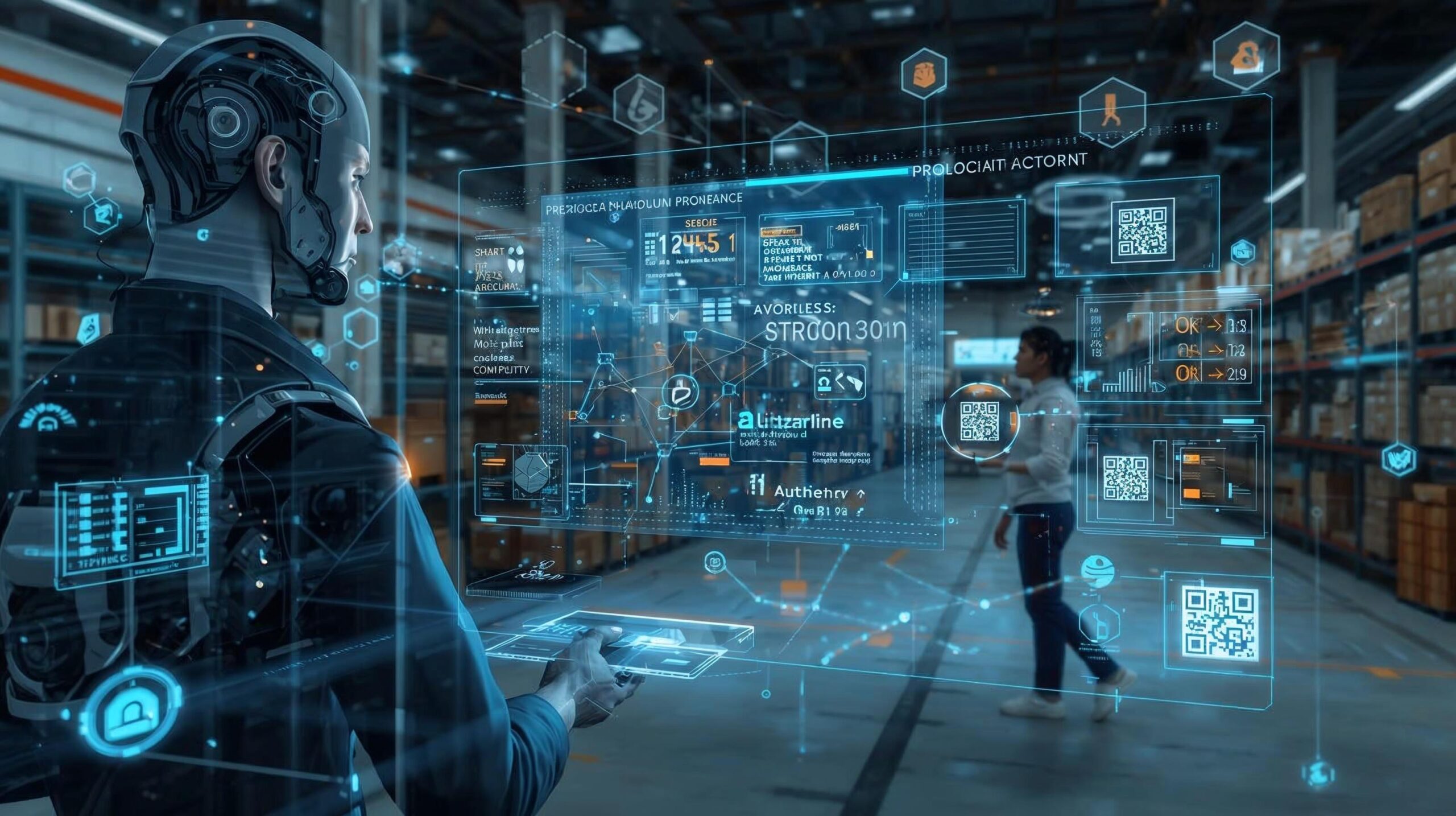
QR codes to view product history — customers can scan these.
Fundamental Benefits Of The Integration Of Blockchain + AI
Full Transparency
It provides transparency and traceability at every stage of the product journey.
Fraud Prevention
Surely counterfeit products are easily identified and blocked.
Ethical Sourcing
Validates that suppliers adhere to ethical and legal guidelines.
Improved Consumer Trust
Des customers feel confidence in product authenticity.
Regulatory Compliance
Simplifies audits and compliance reporting.
Ensuring Product Authenticity
The trade in counterfeit goods is a serious global problem, most notably:
Luxury fashion
Pharmaceuticals
Electronics
Food products
Blockchain ensures:
Unique product identifiers
Verified production records
Tamper-proof ownership history
AI extends this by identifying anomalies like:
Duplicate product entries
Suspicious supplier behavior
Inconsistent shipping data
AI & Blockchain in Ethical Sourcing
Consumers are demanding more products that are produced ethically.
This system ensures:
Fair labor practices
Environmentally responsible sourcing
Verified supplier credentials
As a result, AI nuggets analyze supplier data and blockchain retains compliance permanently.
Supply Chain Traceability
Traceability is tracking every stage a product goes through.
Example Flow:
Raw Material → Manufacturer → Distributor → Retailer → Customer
With blockchain:
Every step is recorded
No data can be altered
Full history is accessible
With AI:
Delays and inefficiencies are detected
Risk predictions are generated
Optimization suggestions are provided
Use Cases Across Industries
Luxury Goods
Authenticates luxury items including handbags and watches
Pharmaceuticals
Verifies drugs authenticity and safe production
Food & Agriculture
Allows the tracking of the journey from farm to table for safety and quality
Fashion Industry
Confirms ethical sourcing of materials.
Electronics
Prevents counterfeit components in devices.
Technologies Behind the System
Blockchain Technology
Provides secure, immutable record-keeping.
Artificial Intelligence
Performs validation and analysis of supply chain data.
Internet of Things (IoT)
Snap real-time environmental and geo data
Smart Contracts
Automates compliance and transactions.
Big Data Analytics
Processes large-scale supply chain information.
Real-World Example
Imagine buying a luxury handbag:
One option is to get a QR code on the product you scan
Blockchain shows raw material sourcing
Confirms where and when it was made
It outputs shipping and retailer information
AI reveals there were no irregularities with the data
Outcome: You know the product is real and ethically sourced.
Benefits for Businesses
Stronger Brand Reputation
Transparency builds customer trust.
Reduced Fraud Losses
Prevents counterfeit infiltration.
Operational Efficiency
AI detects inefficiencies in supply chains.
Competitive Advantage
Transparent businesses attract more customers.
Better Risk Management
Awareness of supply chain problems — early
Benefits for Consumers
Confidence in Purchases
Customers know exactly what they’re getting.
Ethical Assurance
Supports responsible consumption.
Better Product Quality
Verified sourcing improves quality standards.
Easy Verification
Full transparency by simply scanning the QR code.
Challenges in Implementation
High Initial Costs
As an example, the Blockchain and AI system needs investment.
Data Integration Complexity
Combining multiple systems is challenging.
Scalability Issues
The Global Supply Chains The Future of Trade Like also needed strong infrastructure.
Adoption Resistance
Some stakeholders may resist transparency.
Data Accuracy Dependency
The system can only work if the input data is correct.
Best Practices for Implementation
Start with High-Value Products
Prioritize Industries such as Luxury or Pharmaceuticals
Use Standardized Data Formats
Data Validation — Achieving Consistency Across Supply Chain Partners
Integrate IoT Devices
Enable real-time tracking and updates.
Educate Stakeholders
Provide training to suppliers and partners on how to use the system.
Ensure Regulatory Alignment
Meet global data and trade regulatory compliance.
Future Trends
Fully Transparent Supply Chains
End-to-end visibility will become standard.
AI-Powered Autonomous Auditing
AI will continuously verify compliance.
Blockchain-Based Product IDs
Each product will be given a digital identity.
Consumer-Controlled Data Access
Users can manage product data that they want to see.
Sustainability Tracking
Product records will have carbon footprint and environmental impact built-in.
Ethical Considerations
Data Privacy
Protect sensitive supply chain information.
Accuracy of Records
The integrity of the data needs to be maintained at every step.
Fair Access
Do not lock out small suppliers because of technical barriers.
Environmental Impact
Blockchain systems must be energy-efficient.
FAQs:
What is product provenance?
It is the full history of a product, from origin to consumer.
How does blockchain help?
It gives a trusted, immutable ledger of every transaction.
What role does AI play?
AI analyzes the data, detects fraud and optimizes supply chains.
Can consumers verify products?
Yes, usually via QR codes or digital IDs.
Does it prevent counterfeiting?
Yes, which greatly minimizes counterfeit risks.
Is implementation expensive?
Expensive in the beginning but worth it in the end.
How does it improve trust?
With clear, verified histories of their goods.
What are smart contracts?
Agreements that execute automatically per predefined conditions.
The growing trend of product traceability
Completely transparent, AI powered and globally integrated systems.
Conclusion
It is the combination of blockchain and AI that is revolutionizing provenance in a way that is transparent, secure, and smart. The integration of immutable record-keeping with sophisticated analytics ensures authenticity, ethical sourcing, and complete traceability throughout the supply chain.
As consumers increasingly hold companies to account and demand sustainable practices, this technology will be vital for establishing competitive advantage in trust.
Very soon, every product will be able to tell its own unique story — clearly, verifiably and transparently — from point of origin through to ownership.