Private Label vs. Wholesale Amazon: Which Model Wins?

Private Label vs. Wholesale on Amazon: Which Model Builds Real, Defensible Brands?
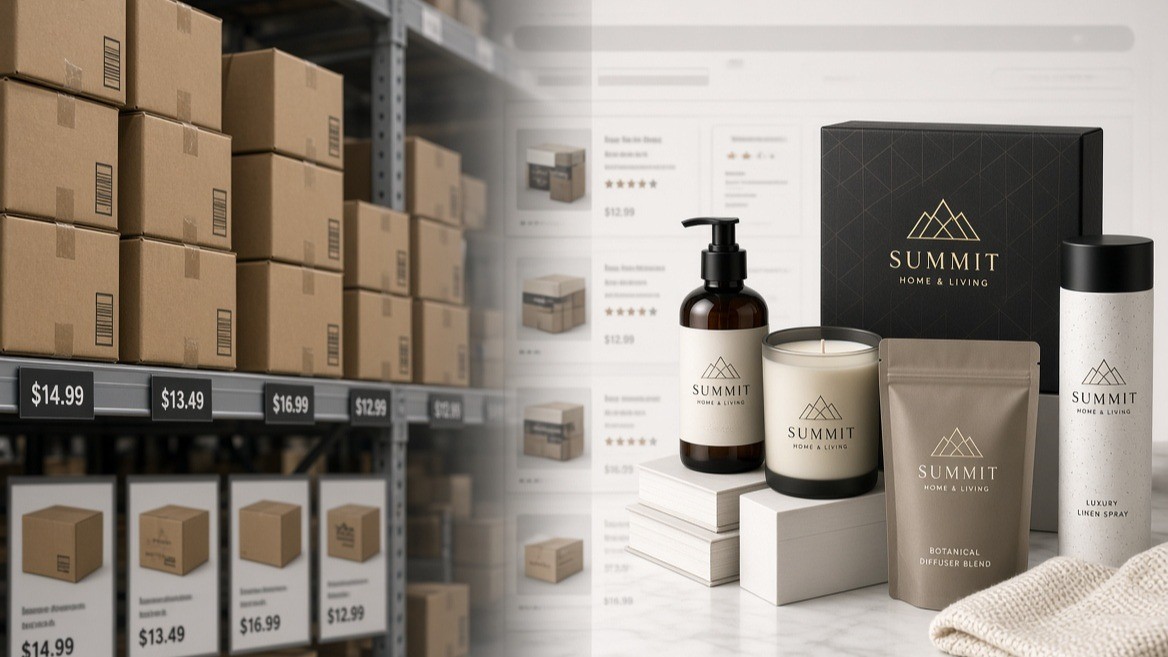
Amazon sellers face a fundamental choice early on: private label or wholesale (also called retail arbitrage or brand reselling in some contexts). Both can generate revenue, but they operate on completely different economics, risk profiles, and long-term trajectories. One creates assets you own and can defend. The other largely rents someone else’s brand equity and competes on razor-thin, commoditized margins.
Here’s a clear-eyed comparison across the five factors that matter most: profitability potential, brand control, competition levels, capital requirements, and long-term scalability—followed by why serious sellers ultimately choose private label and how the right partner changes the outcome.
1. Profitability Potential
Wholesale typically delivers lower and more volatile margins. You buy branded inventory at a discount (often 20–40% off wholesale price) and resell it on Amazon. After Amazon fees (roughly 15% referral + FBA fulfillment), advertising, returns, and storage, net margins commonly land in the 8–15% range on healthy products—and frequently lower when competition spikes or suppliers raise prices. Profit is almost entirely volume-driven and highly sensitive to Buy Box share and algorithmic ranking shifts.
Private label starts with higher product costs (you pay for manufacturing, tooling, and often MOQs) but allows you to set your own retail price. Once you achieve product-market fit and decent conversion, net margins of 25–40%+ are realistic after fees and ads—especially as you optimize landed cost, packaging, and advertising efficiency. The key difference: private label profits compound through brand equity, reviews, and customer lifetime value rather than pure unit volume.
Verdict: Wholesale offers faster early cash flow on proven products. Private label offers structurally higher margins once the brand gains traction.
2. Brand Control
Wholesale sellers have almost none. You are a reseller of someone else’s brand. You cannot control product formulation, packaging design, messaging, or customer experience beyond basic fulfillment and customer service. If the brand owner changes pricing, restricts distribution, or launches their own Amazon store, your business can evaporate overnight. You also inherit any reputation issues the brand already has.
Private label sellers own the brand. You choose the product specs, design the packaging and inserts, control the A+ content and Storefront, decide pricing strategy, and build direct relationships with customers through email, loyalty programs, and off-Amazon channels. That ownership is the foundation of defensibility.
Verdict: Private label wins decisively. Brand control is not a nice-to-have—it is the difference between a business and a temporary arbitrage opportunity.
3. Competition Levels
Wholesale markets are brutally competitive. Popular branded SKUs attract dozens or hundreds of sellers. The Buy Box becomes a race to the bottom on price and fulfillment speed. Amazon’s own algorithms and the brand owner’s authorized sellers further compress margins. Differentiation is extremely difficult.
Private label competition is still intense, but it is different in nature. You compete on product differentiation, branding, reviews, content quality, and advertising efficiency rather than pure price. Niches can be protected through unique formulations, superior packaging, strong review velocity, and brand loyalty. Once you rank and accumulate reviews, the barrier to entry for copycats rises significantly—especially if you continuously improve the product and expand the line.
Verdict: Wholesale is a pure commodity game. Private label allows you to create differentiation and raise switching costs for customers.
4. Capital Requirements
Wholesale generally requires less upfront capital per SKU. You can often start with smaller inventory buys of proven products and test demand quickly. However, to generate meaningful profit, you need high volume, which means larger capital tied up in inventory that turns slowly if rankings slip.
Private label demands more capital at the beginning: product development, samples, tooling or molds (in some categories), larger minimum order quantities, professional photography, packaging design, and initial inventory. First-order investments of $10k–$50k+ per product are common depending on category. Cash flow is slower because of manufacturing and shipping lead times.
The trade-off is that private label capital builds equity in a brand asset, while wholesale capital is continuously recycled into inventory that remains someone else’s brand.
Verdict: Wholesale is a lower barrier to entry. Private label requires more capital but creates higher-value assets.
5. Long-Term Scalability
Wholesale scaling is linear and fragile. Growth comes from adding more SKUs or more units of the same SKUs. Margins stay thin, supplier relationships can change, and Amazon policy or brand restrictions can eliminate entire product lines. Building a transferable business is difficult because the brand equity belongs elsewhere.
Private label scaling is multiplicative. Successful products fund line extensions, brand expansion into adjacent categories, higher-margin variants, and eventual multi-channel distribution (Shopify, retail, wholesale of your brand). Strong private label brands can be sold for significant multiples of revenue because buyers acquire customer lists, review assets, ranking equity, and brand recognition—not just inventory. Many six- and seven-figure exits in the Amazon space are private label brands.
Verdict: Private label is the only model that reliably builds a scalable, sellable, defensible business.
The Strategic Reality
Wholesale can be a useful learning ground or cash-flow engine for some operators, particularly those who excel at sourcing and inventory management. But it is fundamentally a low-moat, high-competition, margin-compressed model. Private label is harder at the start and demands more capital, discipline, and strategic thinking—but it is the path that creates real brand equity and long-term enterprise value.
Most sellers who stay in wholesale for years eventually hit a ceiling: thin margins, constant price pressure, and limited ability to differentiate. Those who transition successfully to private label treat it as brand building, not just product selling.
How AMZ DOC Supports Private Label Sellers
AMZ DOC specializes exclusively in helping private label sellers build defensible brands rather than competing on commoditized wholesale margins. We focus on the work that actually creates moats: product selection grounded in real demand and differentiation potential, brand positioning and packaging that justify premium pricing, launch and ranking strategies that generate review velocity without burning cash, advertising systems that scale profitably, and ongoing product and line expansion that turns a single SKU into a brand portfolio.
We do not treat Amazon as a pure arbitrage marketplace. We treat it as a brand-building platform. That means prioritizing customer experience, review quality, content depth, and operational excellence so your products become harder to copy and more valuable over time.
If you are ready to move beyond thin wholesale margins and build a brand you actually own, the private label path, executed with the right support, is the clearer route to sustainable profitability and long-term scalability.