Smart Autonomous Drone Delivery for Cost-Efficient Last Mile

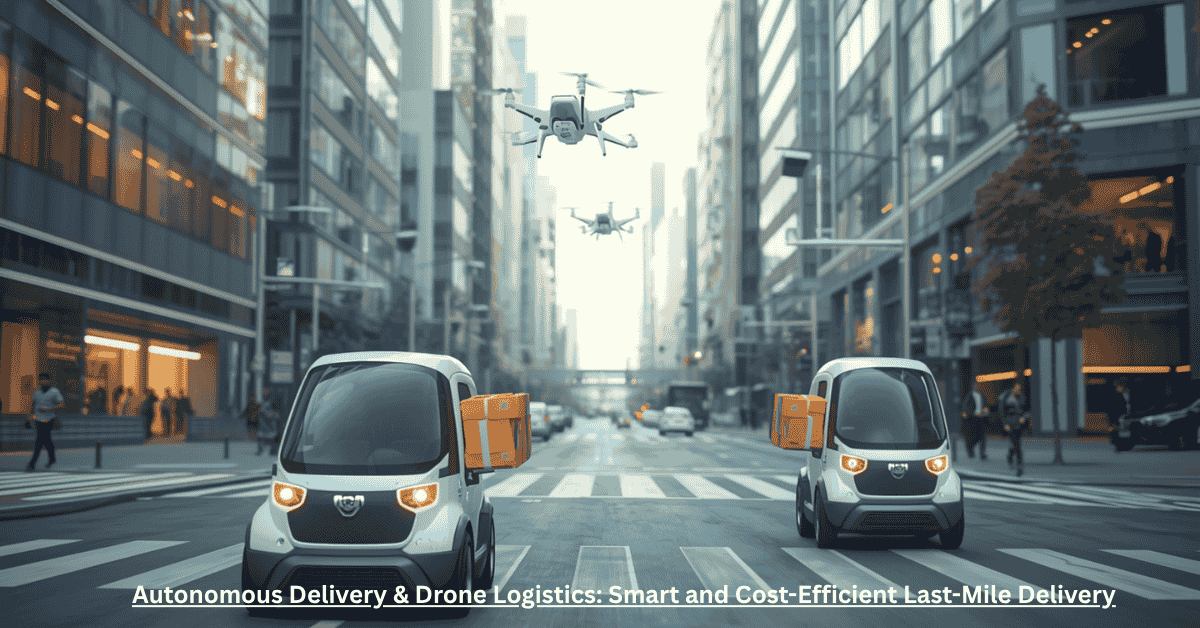
Autonomous Delivery & Drone Logistics: Smart and Cost-Efficient Last-Mile Delivery
Fast and reliable delivery service ought to be the name of the game when it comes to the delivery service and logistics industry. From delivery of groceries, medication, and even meals to e-commerce orders, people want the service to be immediate.
As the demand grows, and to avoid losing customers, businesses are being forced to innovate and improve their service. This is assisting in the creation of autonomous delivery, drone logistics solutions, and robotic systems, which will assist in delivery services for the last mile.
The means of logistics and delivery services are changing because of the innovations that are being implemented.
The purpose of this article is to provide helpful examples and knowledge to demonstrate the delivery systems of the future and how they are increasing both the efficiency and cost-effectiveness of the delivery services.
Autonomous Delivery: What is it?
The term also means that people are not delivering the packages. Drones, robots, and self-driving vehicles will be responsible for the delivery.
When delivering packages, the vehicles will be equipped with the following:
- Artificial Intelligence (AI)
- GPS
- Sensors, which will be used for
- Cameras and Machine Learning
- The ability to process data in real time
Last-Mile Delivery: What is it?
Last mile delivery is the last stage of delivery and is the final point where a product is transported and is to be delivered to the customer.
This stage of delivery is:
Most expensive
Most time-consuming
Most complex
In many cases last-mile delivery is over 50% of shipping costs. This fact is precisely the reason businesses are investing so heavily into automation.
Types of Automated Delivery Solutions
- Delivery by Drone
Drones are air transport that deliver items via the air.
Basic Benefits:
- Saves time when road traffic is busy.
- Flies over roads to bypass traffic.
- Delivering small, time-sensitive items is ideal.
Scenario:
A patient orders medicine, and is able to receive it within 20 minutes via drone delivery.
- Delivery via Robots
Delivery robots are small machines that are able to drive on roads and sidewalks.
Basic Benefits:
- Delivery over short distances.
- Safe to travel around and deliver.
- Energy-efficient.
- Grocery and food delivery works best.
Scenario:
A customer is able to receive food from a restaurant that is located nearby, thanks to robot delivery.
- Deliveries Made in Self-Driving Vehicles
Self driving trucks and/or vans are able to deliver products without the help of a driver.
Basic Benefits:
- Delivering large amounts of product is possible.
- 24 hour operation is possible.
- Labor costs are able to be lowered.
Scenario:
A self-driving van crosses several roads in a large city to make multiple deliveries.
Description of How Deliveries are Made and Returned
Automatous delivery can be indirect and direct.
- Placing an Order
A customer is able to do this via the web.
- Processing the Order
A warehouse begins to prepare and pack the products to be sent.
Here’s how autonomous delivery works:
Assignment
The AI technology will allocate the most optimal delivery method: drone, robot, or vehicle.
Navigation
Using GPS and other sensors, the system identifies the best route to the delivery point.
Delivery
The product is delivered to the specified destination.
Confirmation
Delivery is either confirmed or the customer is given delivery.
Advantages of Autonomous Delivery
- Quicker Delivery
Drones and delivery robots can bypass standard traffic delays for quicker delivery. - Lower Operating Costs
Drivers are no longer needed, and costs associated with fuel and other labor costs are greatly diminished. - Around the Clock Delivery
Automation and autonomous technologies provide the capability to operate without interruption. - Greater Precision
Delivery errors are significantly lowered with the implementation of artificial intelligence. - Reduced Environmental Impact
The use of battery-powered robots and drones supports a reduction in the carbon footprint.
Autonomous Delivery Around the World
- Restaurant Delivery Robots
In several locations in the world, small robots are delivering orders directly from restaurants to the customers’ houses and offices. - Medicine Delivery Drones
In remote locations, emergency medicine delivery is made via drones. - Online Retail Deliveries
For faster delivery, online retailers are piloting delivery drones and autonomous vehicles.
Autonomous Delivery and AI
The artificial intelligence technology for autonomous delivery is responsible for route planning, obstacle detection, traffic forecasting, delivery timing, and demand forecasting. With the use of AI, delivery is not only quick but is also efficient and safe.
Issues with Autonomous Delivery
There are a number of issues with autonomous delivery, including:
- Regulation Issues
Limiting government policy on drone delivery
- Safety Concerns
There may be accidents or flaws with the systems and delivery may be unsafe
- Weather Conditions
Rain, wind, and storms can impede the operational performance of delivery systems
- High Initial Investment
The initial cost required to operationalize the delivery systems may be too high
- Public Acceptance
Robotic delivery may be a problem for people
Cost Reduction Through Automation
With autonomous delivery, businesses avoid costs related to:
Salaries for drivers
Fuel for delivery vehicles
Time spent on the delivery of the goods/services
Operational mistakes
Poor delivery route
Ineffective delivery route
The profit margins increase with the above saved costs in the longterm
Potential Applications by Sector
- Health Sector
Medicine delivery
Emergency supplies delivery
Blood delivery
- Food Sector
Fast-Food Delivery
Grocery Delivery
Contactless Delivery - Retail & E-Commerce:
Same-day delivery
Express delivery
Smart Logistics
- Logistics Company:
Delivery from warehouse to hub
Automated fleet management
Delivery automation in urban and rural areas
Urban Areas:
- High demand
- Traffic issues
- Ideal for drones and robots
Rural Areas:
- Long distances
- Limited infrastructure
- Drones are especially useful
Safety in delivery automation
To ensure that deliveries are carried out safely, the systems:
- Include sensors that detect collisions
- Have Emergency stop systems
- Have systems that allow the activities of the delivery systems to be monitored
- Have systems that lock the package.
Future of Drones and Automated Logistics
The future of automated and drone logistics looks promising, and with the current rapid advances, we can expect:
- Smart cities that are fully automated
- Highways for drones in the sky
- Delivery systems that are powered by AI
- Automated systems integrated with smart homes
- Delivery systems that are faster and more accurate
Soon delivery that is automated will be the rule and not the exception.
How businesses can utilize automated delivery
STEP 1. Start small.
- Test pilot projects in restricted areas.
STEP 2. Go for the right technology.
- Choose drones, robots, or automated vehicles based on needs.
STEP 3. Collaborate with Tech Providers.
- Work with automation providers.
STEP 4. Make sure to comply.
- Comply with legal, national, or local laws.Step 5: Train Teams
Educate personnel on how to manage and control systems.
Practical Example Scenario
Let’s say a customer places a grocery order at 6 PM.
AI captures and processes this order immediately.
The closest warehouse to the customer funds the order.
The order is packaged, and a delivery robot is assigned to the order.
The robot is able to drive to the customer’s home while avoiding obstacles and other drivers.
The delivery is done within 30 minutes.
There are no traffic delays and there is no human driver which makes this whole process fast and efficient.
Advantages for Customers
Better customer service
Contactless delivery
Real time order tracking
Faster order deliveries
Lower delivery prices
Limitations to Consider
Possibility of cyber threats
Environmental impacts
Fuel consumption may increase
Increased dependency on technology
Inadequate delivery infrastructure
Autonomous delivery systems are more eco-friendly because
They use electric power
Reduce fuel consumption
Lower carbon emissions
Support sustainable logistics
Conclusion
Autonomous delivery and drone logistics are the delivery systems of the future. They are revolutionizing the last mile delivery challenges and helping businesses deliver faster, cheaper, and better than ever.
The challenges autonomous delivery systems face are shadowed by the benefits. As technology advances, autonomous delivery systems are sure to become more sophisticated, reliable, and widely accepted.
Businesses that strategically integrate these solutions will have a distinct competitive edge.
FAQ
- What is meant by autonomous delivery?
Autonomous delivery is the process of delivering items without a human driver. This is done through the use of self-driving cars, delivery robots, and drones.
- How do delivery drones operate?
Delivery drones use artificial intelligence (Ai) and sensors to determine the best route to a customer’s location.
- Are delivery robots safe to use?
Yes, delivery robots and drones have systems that detect and avoid obstacles.
- What are the advantages of using autonomous delivery services?
Autonomous delivery services are fast, cheap, and better for the delivery services.
- Are there limits to what drones can deliver?
Yes, delivery drones have limits to what they can deliver. They can only deliver lightweight packages.
- Are there autonomous delivery services everywhere?
No, autonomous delivery services are being tested worldwide.
- How do delivery systems use Ai?
Delivery systems use Ai to determine the best route to the end destination.
- What industries use autonomous delivery services?
Some industries that use autonomous delivery services are the healthcare, food delivery, logistics, and e-commerce industries.
- What are some challenges to providing autonomous delivery services?
Some challenges to providing autonomous delivery services are safety, weather, and regulations.
- What does the future hold for delivery systems?
In the future, delivery systems are expected to be faster and more efficient.