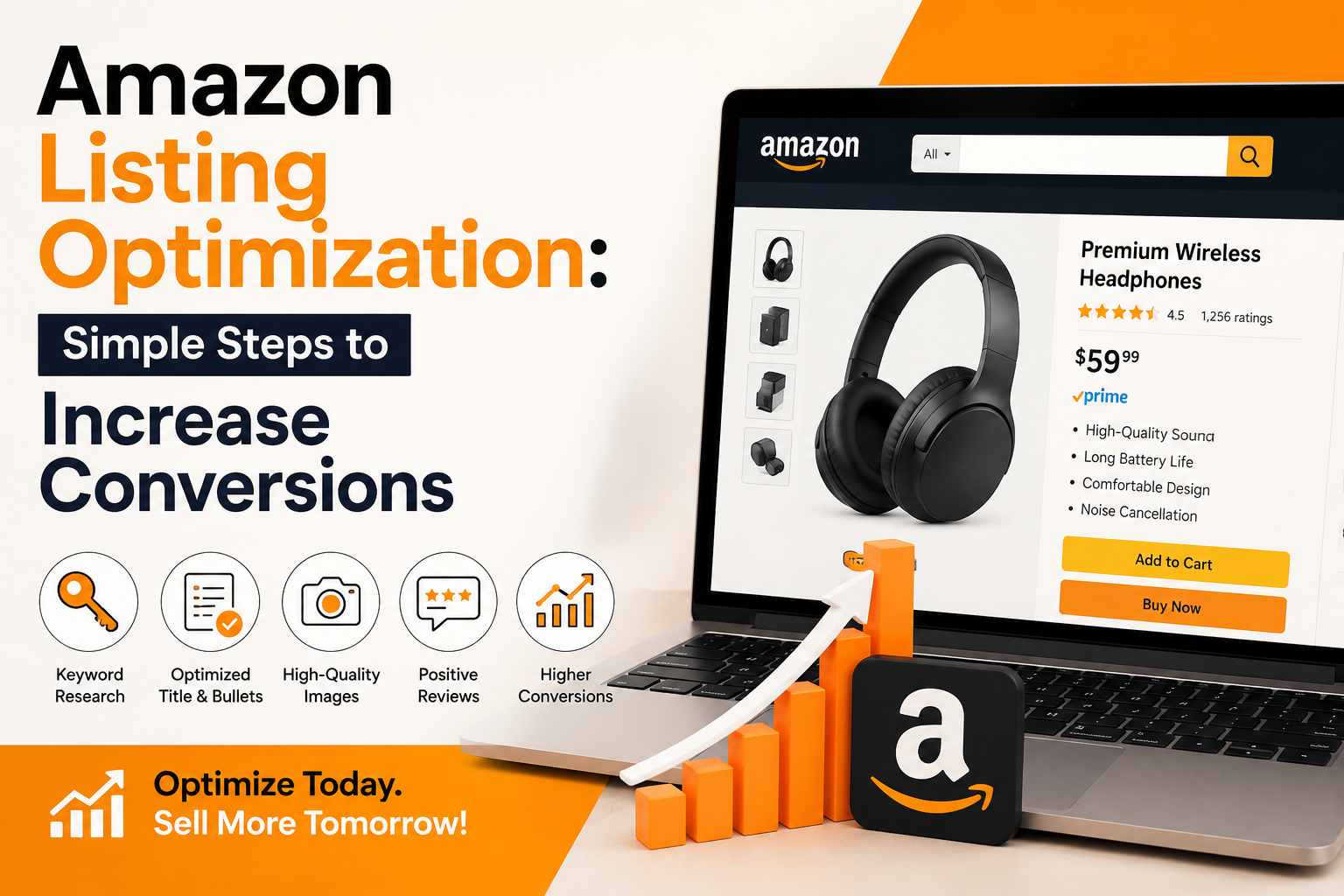
Amazon Listing Optimization: Simple Steps to Increase Conversions

On Amazon, being successful is not just about listing products then waiting for customers to buy! Listing optimization – If you are a seller on Amazon, your listings get lost in the ocean of millions of products vying for attention so sellers need to optimize the listing to gain visibility and attract potential buyers thus bringing in conversions. One of the best ways to increase sales and rank, Build a successful eCommerce business is by optimizing your Amazon listing.
An Amazon listing that is well-optimized enables customers to understand the benefits of a product almost instantly and allows them to make an informed decision after building trust, leading to finalizing the purchase. Regardless if you just started selling on Amazon or if you are an established brand, the benefits of mastering the art of seller central listing optimization can be life-changing to your business revenue and profitability.
A full guide to the best practices for Amazon listing optimization and how to build product pages that convert to drive sales growth over time.
What Is Amazon Listing Optimization?
What Amazon listing optimization is, first of all, it is optimizing the various elements of a product listing to improve the ranking in organic search results and thus improve conversion rates.
The main objectives of the optimization are:
Improve product rankings
Increase organic traffic
Enhance customer experience
Boost conversion rates
Increase sales and profitability
Your Amazon listing is completely optimized with:
Keyword-rich product title
High-quality images
Informative bullet points
Detailed product description
Backend search terms
Competitive pricing
Positive customer reviews
Enhanced Brand Content (A+ Content)
Each component serves as a critical element to facilitate the decision-making process for consumers prior to purchase.
Why Amazon Listing Optimization Matters
Amazon search engine — Amazon is basically a product search engine. The customers look for keywords, scan the results and buy products that seem reliable and appropriate.
Even the best products may lose visibility without optimization.
Benefits of optimized listings include:
Higher search rankings
Increased organic traffic
Better click-through rates
More conversions
Improved customer trust
Greater advertising efficiency
Higher overall sales
A higher-quality listing will result in more customers being willing to buy your product.
An introduction to Amazon basic knowledge of A9 and A10 algorithm
Amazon Follow the process of search A on Search Result It is an algorithm followed to get products into Amazon.
Amazon does not reveal every ranking signal, but some convey:
Keyword relevance
Sales history
Conversion rate
Product availability
Customer reviews
Pricing competitiveness
Click-through rate
Seller performance
Well-optimized listings help Amazon understand your product so they can show it for a customer search.
Conduct Thorough Keyword Research
The basis for Amazon listing optimization lies in the keyword research.
Without good keywords, customers may never discover your offerings.
Types of Keywords
Primary Keywords
These are the top search words customers use.
Example:
Amazon listing optimization
Wireless earbuds
Gaming keyboard
Secondary Keywords
Search phrases that are thematic neighbors to the major keywords you focus on.
Example:
Noise-canceling earbuds
Bluetooth headphones
Mechanical gaming keyboard
Long-Tail Keywords
Longer search terms that are less competitive.
Example:
Wireless earbuds for running
Waterproof Bluetooth earbuds
Long-tail keywords tend to convert better as they are search terms at the end of the funnel, and thus have a defined buying intent on the part of the customers.
Optimize Your Amazon Product Title
Considered as one of the most crucial ranking and conversion factors, the product title
A strong title should:
Include primary keywords
Clearly identify the product
Highlight key features
Remain easy to read
Example:
Some of them are very well-written with accurate information but some just left me wondering and wandering through pages.
Title Best Practices
How to Use Keywords Placing of Primary keywords- Place primary keywords near the start.
Avoid keyword stuffing.
Follow Amazon category guidelines.
Make titles readable for humans.
Include important buying information.
Create High-Quality Product Images
Images are what shoppers see first.
Most buyers are influenced in their purchasing decisions based mainly on product images.
Essential Image Types
Main Product Image
White background
High resolution
Maintain the product in a variety of settings using minimal tools.
Lifestyle Images
Demonstrate the product in action.
Infographic Images
Highlight:
Features
Benefits
Dimensions
Specifications
Comparison Images
Compare your product with formal alternatives or competitors, or even just previous versions.
Close-Up Images
Considerations Regarding the Quality of Showings, Material and Important Points
Image Optimization Tips
Use at least seven i
mages.
Upload high-resolution photos.
Enable zoom functionality.
Showcase unique selling points.
Using professional images can increase your conversions.
Write Compelling Bullet Points
Bullet points give the customers a brief overview of your product.
Bullet point scanning – Most shoppers will scan the bullet points then read the descriptions.
What to Include
Key Features
Explain product specifications.
Customer Benefits
Get to your why — how the product does things.
Unique Selling Points
Demonstrate how your product stands out
Product Quality
Highlight materials, durability, and craftsmanship.
Warranty or Support
Mention guarantees when applicable.
Example
Instead of:
“Made with stainless steel.”
Write:
The long-lasting and rust-resistant nature formulated makes the device made of premium stainless steel.
You will notice that Benefits usually lead to a better conversion than plain features.
Craft an Effective Product Description
You have a product description where you can be as specific as possible.
A strong description should:
Explain product benefits
Address customer concerns
Reinforce purchasing decisions
Include relevant keywords naturally
Tell a story, Use case, what can customers achieve rather than the technical specification.
A+ Content: Preparing for success
Amazon A+ Content is available for all registered brands.
With A+ Content, sellers are able to add:
Enhanced images
Comparison charts
Branded content
Detailed product information
Benefits include:
Higher conversion rates
Better customer engagement
Stronger brand identity
Reduced return rates
A+ Content is also a great way to enhance the customer shopping experience — giving it an almost professional touch.
Optimize Backend Search Terms
Backend keywords are invisible search terms that a customer cannot see.
They assist Amazon in comprehending more product relevance.
Best Practices
Use relevant keywords.
Avoid repetition.
Include alternative spellings.
Add synonyms.
Exclude competitor brand names.
Stay within Amazon’s character limits.
Backend keywords have an extra opportunity to rank but will not be displayed on-screen.
Focus on Customer Benefits
Sellers are often guilty of one of the biggest mistakes which is to focus on features.
Customers care more about outcomes.
Feature
“5000mAh Battery”
Benefit
“All day battery. Recharge 0-100% in as little as 28 minutes.”
Benefits allow customers to picture themselves using the product and living a better life.
Improve Product Reviews
Reviews heavily influence purchasing decisions.
Products with good reviews convert better.
How to Increase Reviews
Deliver quality products
Provide accurate descriptions
Offer excellent customer service
AmazonRequest review
Follow Amazon’s review policies
Never buy fake reviews or break the Amazon guidelines.
Maintain Competitive Pricing
Price directly affects conversion rates.
Before making a purchase, customers often do comparison shopping on similar products.
Consider:
Competitor pricing
Product quality
Shipping costs
Brand positioning
The lowest price is not always the best strategy.
Value focused, not cheapest
Optimize for Mobile Shoppers
A good amount of Amazon shoppers use mobile steps to shop.
Ensure your listing:
Uses clear images
Has concise bullet points
Features easy-to-read content
Displays important information early
You get more engagement with mobile-friendly listings.
Conversion Rate Optimization And Trust Signals
Consumers purchase from listings they have faith in.
Trust-building elements include:
High-quality images
Detailed descriptions
Positive reviews
Fast shipping
Professional branding
Clear policies
Trust reduces purchase hesitation.
Monitor Listing Performance
Optimization is an ongoing process.
Track key metrics such as:
Sessions
Click-through rate
Conversion rate
Sales volume
Advertising performance
Keyword rankings
Regular review might reveal areas where you could improve.
A/B Test Listing Elements
Testing reveals what works best
Elements to test include:
Product titles
Images
Bullet points
A+ Content
Pricing
A few small optimisations can bring you a massive amount of sales over time.
Common Amazon Listing Optimization Mistakes
Keyword Stuffing
You can overdo it with keywords so be wary; too many keywords hurt readability.
Write in a natural way with search terms relevant to your topic.
Poor Product Images
Trust and conversions are also diminished by images of poor quality.
Use professional photography when possible.
Ignoring Customer Questions
Review customer questions regularly.
Leverage their issues to make revisions in listing data.
Weak Bullet Points
Value is not conveyed in bland bullet points.
Focus on benefits and problem-solving.
Inaccurate Descriptions
False info drives up returns and negative reviews.
Always ensure accuracy.
Neglecting Backend Keywords
Sellers missed out on essential external Keyword opportunities.
Amazon SEO Best Practices
To improve rankings:
Conduct regular keyword research.
Use keywords naturally.
Optimize titles and bullet points.
Maintain inventory availability.
Generate positive reviews.
Improve conversion rates.
Monitor competitors.
Update listings regularly.
Amazon incentivizes listings that meet the intent of searchers.
Advanced Listing Optimization Strategies
Most experienced sellers use advanced techniques.
Competitor Analysis
Study top-performing competitors.
Analyze:
Keywords
Images
Pricing
Reviews
Product positioning
Search Query Analysis
Find converting search terms using Amazon advertising reports.
Add successful keywords to listings.
Conversion Rate Optimization
Focus on improving:
Images
Pricing
Reviews
Product content
Usually, higher conversion rates will give you better rankings.
Brand Building
Strong brands typically enjoy:
Higher customer loyalty
Better conversion rates
Increased repeat purchases
Utilize consistent branding in all listings.
Amazon continues evolving.
Future trends include:
AI-powered content creation
Visual search improvements
Enhanced personalization
Better product recommendation systems
Advanced analytics tools
Sellers with continuously optimized listings will stay in business.
Final Thoughts
Amazon listing optimization is one the most effective tools for sellers to help them boost conversion, ranking and build their business All factors influencing performance: keyword research, product title and images, bullet points and customer reviews.
The best sellers view optimization as an ongoing exercise, not a one-time event. Through data, you will be able to constantly optimize your listings, use performance metrics and see customer behavior that helps you create product pages capable of converting well resulting in continuous sales & long term business success.
Spending time and energy getting your Amazon listings optimized today will reap you powerful rewards in terms of visibility, traffic, conversions, and profits for years to come.
FAQs
What is Amazon listing optimization?
Amazon listing optimization refers to the optimization of product titles, images, bullet points, descriptions, keywords and other elements of a listing for visibility and conversion rate.
Importance of Optimizing Your Listings on Amazon
It enables products to appear prominently in search results, gain high traffic volume, enhance conversion rates and maximize sales.
How many key-word phrases should I use in an Amazon listing?
Make sure to use your main keyword as much as naturally reasonable in the title, bullet points, description and backend search terms, including some of them too.
What are backend keywords in Amazon?
Backend keywords are concealed search phrases that Amazon uses to comprehend the relevance of your product.
Despite having titles and bullet points, Amazon customers cannot touch the product they want to buy.
Amazon sellers should use a minimum of 6 to 7 high quality, lifestyle and infographic images.
What is A+ Content?
A+ Content is an Amazon function which allows brand registered sellers to add enhanced images`, charts and branded content on product pages.
Do customer reviews affect conversions?
Yes. Good reviews mean that you gain trust, credibility and greatly affect the purchase of your customers.
How frequently Should I Update My Amazon listing?
Check-in on listings regularly, especially if sales slow down and new keywords appear or competitors adjust their strategies.
Can better images lift Amazon sales?
Absolutely. This type of photo is often the sole reason customers can understand the product more clearly, and this increases click-through rates and conversion rates with high-quality pictures.
Amazon listing optimization – what matters most?
The listing success rests on the collective data of keyword relevance, high-quality images, persuasive product content, positive reviews & strong conversion rates.