Amazon PPC Campaign Structure for Maximum Sales Growth

Amazon PPC Campaign Structure for Maximum Sales Growth
Selling on Amazon has become increasingly competitive, making it essential for businesses to invest in a well-planned advertising strategy. A properly organized Amazon PPC campaign structure helps sellers control their budgets, improve ad performance, and achieve higher returns on investment. Instead of creating random campaigns and hoping for results, successful sellers build a structured system that allows every campaign to serve a specific purpose.
Whether you are launching a new product or scaling an established brand, your campaign structure directly impacts your advertising success. A strategic approach enables better keyword management, cleaner reporting, and easier optimization over time. At AMZ-DOC, we believe that a strong campaign foundation is one of the most important factors behind profitable Amazon advertising. Learn more about our services at AMZ-DOC.
What Is an Amazon PPC Campaign Structure?
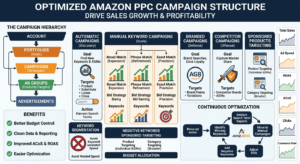
An Amazon PPC campaign structure refers to the organized way advertisers create and manage their campaigns, ad groups, keywords, bids, and products. Instead of placing every product into one campaign, sellers divide campaigns based on clear objectives.
A structured account makes it easier to monitor performance, identify winning keywords, eliminate wasted spending, and increase conversions. It also helps advertisers make faster decisions because campaign data remains organized and easy to understand.
Without a proper structure, campaigns often become confusing, making optimization difficult and reducing advertising efficiency.
Why Campaign Structure Matters
A well-organized campaign structure offers several important benefits.
First, it provides better budget control. You can allocate more budget to high-performing campaigns while limiting spending on underperforming ones.
Second, it improves keyword tracking. Since keywords are separated into logical campaigns, identifying profitable search terms becomes much easier.
Third, optimization becomes more efficient. Advertisers can adjust bids, pause ineffective keywords, and improve targeting without affecting unrelated campaigns.
Finally, organized campaigns produce more accurate reports, allowing sellers to make data-driven decisions with confidence.
Build Separate Campaigns for Different Goals
Every Amazon advertising campaign should have a clear objective.
For example, one campaign may focus on discovering new keywords, while another targets proven high-converting keywords. Some campaigns may defend branded searches, while others compete against competitors’ products.
Separating campaigns based on goals prevents unnecessary overlap and allows each campaign to perform its intended role.
A common campaign breakdown includes:
- Automatic campaigns
- Manual keyword campaigns
- Branded campaigns
- Competitor campaigns
- Product targeting campaigns
- Seasonal promotion campaigns
This organized approach keeps advertising efforts focused and measurable.
Start with Automatic Campaigns
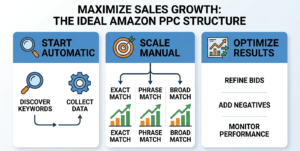
Automatic campaigns are an excellent starting point, especially for new product launches.
Amazon automatically matches your products with relevant customer searches, helping you discover valuable keywords that you may not have considered.
These campaigns provide important search term data that can later be transferred into manual campaigns for better control.
Many experienced advertisers continue running automatic campaigns because they consistently reveal new keyword opportunities.
Create Manual Campaigns for Greater Control
Once you collect keyword data, create manual campaigns using your best-performing search terms.
Manual campaigns allow you to choose exactly which keywords to target while setting individual bids for each one.
Most successful advertisers divide manual campaigns into different match types, including:
- Exact Match
- Phrase Match
- Broad Match
Separating match types prevents keyword competition within the same campaign and makes optimization much simpler.
Exact match campaigns usually receive higher bids because they often deliver stronger conversion rates.
Organize Products Carefully
Each campaign should contain closely related products.
Avoid placing unrelated products in a single campaign because their performance data becomes mixed, making optimization difficult.
For example, if you sell kitchen accessories and fitness products, each category should have separate campaigns.
Some sellers even create individual campaigns for each ASIN to gain maximum control over bids and advertising performance.
A clean product organization leads to clearer reporting and better decision-making.
Use Keyword Segmentation
Keyword segmentation is another important part of an effective PPC structure.
Instead of placing every keyword into one ad group, organize them according to relevance, search volume, or buying intent.
High-converting keywords deserve their own campaigns with competitive bids.
Medium-performing keywords may require moderate budgets, while experimental keywords can remain in testing campaigns.
This approach protects profitable keywords while allowing continuous keyword discovery.
Implement Negative Keywords
Negative keywords prevent your ads from appearing for irrelevant searches.
Adding negative keywords reduces wasted advertising spend and improves overall campaign efficiency.
Review your search term reports regularly to identify searches that generate clicks but no sales.
Adding those terms as negative keywords helps focus your budget on customers who are more likely to purchase.
Consistent negative keyword management significantly improves advertising profitability over time.
Allocate Budgets Strategically
Not every campaign should receive the same daily budget.
Allocate higher budgets to campaigns that consistently generate profitable sales.
Discovery campaigns may require smaller budgets because their primary purpose is keyword research rather than immediate profitability.
Branded campaigns often produce excellent returns with relatively low costs, while competitor campaigns may require more aggressive bidding.
Budget allocation should always reflect campaign objectives and historical performance.
Monitor Performance Regularly
Even the best campaign structure requires continuous monitoring.
Successful Amazon advertisers review key performance indicators regularly, including:
- Advertising Cost of Sales (ACoS)
- Return on Ad Spend (ROAS)
- Click-Through Rate (CTR)
- Conversion Rate
- Cost Per Click (CPC)
- Total Sales
Monitoring these metrics helps identify optimization opportunities before advertising costs increase unnecessarily.
Weekly reviews are generally sufficient for stable campaigns, while newly launched products may require daily monitoring.
Scale Winning Campaigns
Once a campaign consistently performs well, gradually increase its budget instead of making sudden changes.
Small budget increases allow Amazon’s algorithm to adjust without disrupting performance.
Winning keywords can also be expanded into additional campaigns using different bidding strategies or targeting methods.
Scaling gradually helps maintain profitability while increasing total sales.
Avoid Common Campaign Structure Mistakes
Many sellers unknowingly reduce campaign performance through poor organization.
Some common mistakes include:
- Combining unrelated products
- Mixing all keyword match types together
- Ignoring negative keywords
- Creating duplicate keyword targeting
- Setting identical bids for every keyword
- Failing to review search term reports
Avoiding these mistakes creates a cleaner account that is easier to optimize and scale.
Continuously Optimize Your Structure
Amazon advertising is constantly evolving.
Customer behavior changes, competitors adjust their strategies, and new keywords emerge throughout the year.
Regular campaign optimization ensures your account continues performing efficiently.
Review keyword performance, adjust bids, test new targeting methods, and eliminate underperforming campaigns on a consistent schedule.
Small improvements made regularly often produce significant long-term growth.
Conclusion
A well-designed Amazon PPC campaign structure provides the foundation for profitable advertising success. By separating campaigns according to goals, organizing products logically, managing keywords effectively, and continuously optimizing performance, sellers can maximize visibility while keeping advertising costs under control.
Rather than relying on guesswork, a structured PPC strategy allows businesses to make informed decisions based on real data. Over time, this approach leads to stronger rankings, higher conversion rates, and sustainable sales growth.
If you want to build, optimize, or scale your Amazon advertising campaigns, AMZ-DOC offers professional solutions designed to help sellers achieve measurable results. Visit AMZ-DOC to learn more about improving your Amazon PPC performance with expert guidance.