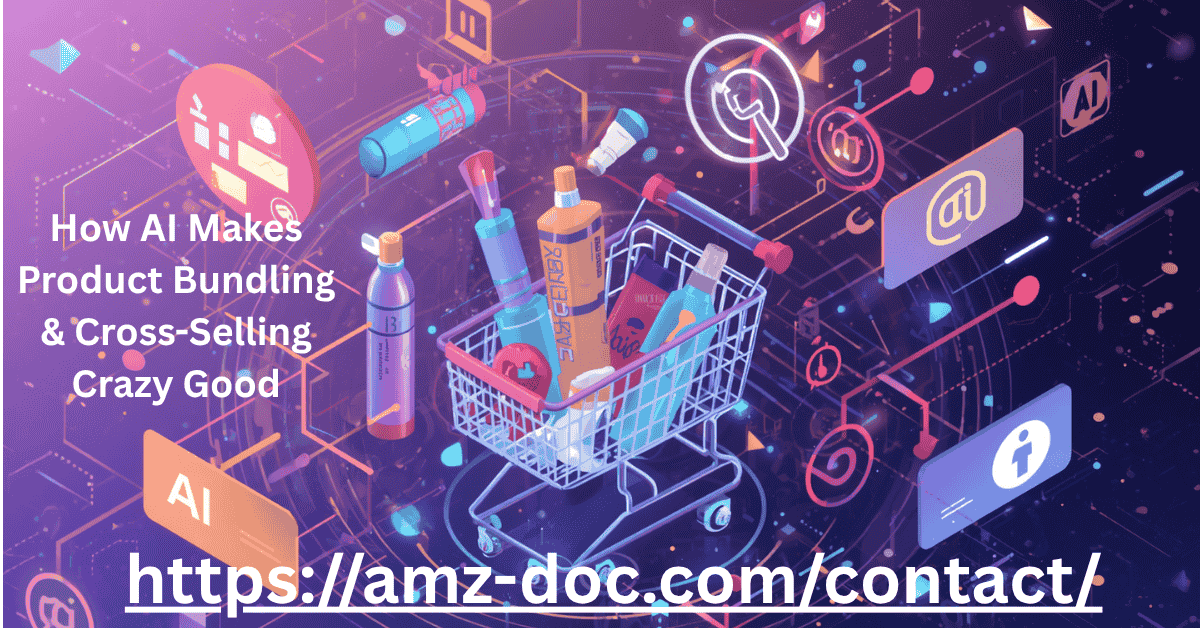
How AI Makes Product Bundling & Cross-Selling Crazy Good

Picture walking into a shop, and the sales associate knows what you want before you say anything. They recommend an ideal mix of products that gets the job done and saves you a bunch of cash. This is not magic; it is AI enhancing the shopping experience with smart product bundling and cross-selling.
In the fast-paced marketplace, businesses are in a race for profit and customer satisfaction. While traditional methods of suggesting add-on products can feel unnecessary, AI has changed the game for the better.
Using AI to drive product bundling allows for the creation of aesthetically pleasing product packages that cross-sell and up-sell more effectively. This is done by suggesting add-on products that go well with what the customer is already purchasing; AI does not create empty suggestions.
The AI Revolution in Product Bundling
The product bundling concept isn’t new, but AI has catapulted it to new heights. Where traditional bundling would rely on instinct and simple sales data out of necessity, and likely missing far more opportunities, an AI bundling product would never make those mistakes. For example, traditional bundling would likely pair chips and soda together, without understanding customer behaviors enough to consider the ineffectiveness of those bundles.
In order to create product bundles that make sense individually and as part of the larger product set, AI bundling products look at exponentially more data and detect patterns and relationships that no human could hope to uncover, including datasets that record purchase histories, previous behavior to predict future behavior, and social media engagement. Custom product bundles, meticulously designed to meet the needs of individual customers as identified by AI systems, are now powered by the notion that customers who purchase yoga mats (and shop on a Monday morning) are more likely to purchase herbal tea in the subsequent week.
Most personalization systems produce static bundles offered to all visitors, regardless of their preferences, prior purchases, or current activity. In contrast, our solution offers visitors bundles that dynamically change to reflect their interests. For example, a workout enthusiast will receive a bundle that offers workout equipment and a protein powder, while a cooking enthusiast will receive a bundle that offers cooking gadgets and specialty ingredients.
Modern AI systems also assess timing and context to create bundles. For example, they know that school holidays will require different bundles than Christmas holidays. Technology can assess the weather, events, or fads and create bundles that fit the current moment. When personalization tools are able to create offers that match the customer’s need, they greatly enhance the customer experience and the businesses benefit through volume of purchases and customer satisfaction.
The Science Behind AI Cross Selling
The scientific approach to AI Cross Selling is more advanced than simply showing “other buyers also purchased this”, or “other buyers also purchased that.” Advanced AI uses Machine Learning to model the relationships between the multitude of products, customer behavior, and the corresponding purchasing trends. This technological approach allows the system to dynamically learn from each customer interaction, to improve its performance.
The first stage is data collection at all possible touch points. AI collects all the data that involves customer service, website visits, social media, and how long they look at a number of products. All of this data gives AI the opportunity to create detailed customer profiles that help identify the customer’s preferences, needs, and buying patterns that may not be apparent from the buying data history.
The next step is using machine-learning algorithms to identify potential patterns that may not be obvious. An example of this is buying expensive coffee beans may not look connected to buying expensive headphones, but that is a potential connection the system identifies. This gives the opportunity to create not obvious valuable cross selling.
The AI creates image offers based on the emotional state and journey of the customer. If the customer is looking at baby goods for the first time, the system assumes they may be a new parent and may require more holistic solutions than standalone products. The cross selling offers are more helpful when they tackle the core problem instead of the problem of just increasing the customer’s shopping cart.
With predictive analytics, businesses can assess when it would make the most sense to make cross-selling recommendations. AI is able to help identify the times customers would be most open to the suggestions, based on their behavioral patterns and their buying cycle. This circumvents offering customers suggestions too often, and ultimately increases the probability of a successful cross-sale when the customer is interested in buying a related product.
Case Studies in Predictive Analytics
The most well known example of successful AI-driven cross-selling and bundling is Amazon. With a recommendation engine that accounts for $35 out of every $100 earned, it’s easy to see the value in this strategy. Amazon’s AI analyzes the buying patterns of millions of customers to offer products that seem hand-picked for the individual customer. Amazon also cross-sells via automated email marketing to encourage customers to complete their buying journey, so the AI has the opportunity for every customer to use the “Frequently Bought Together” tool for different products.
An illustrative case of AI bundling, even if it is in a different sector, is Netflix. While Netflix does not bundle physical products, it bundles experience by providing tailored content suggestions and experiential sameness. The Netflix AI bundles content by analyzing a user’s watch history, time of day, device, and pauses and skips in content. These tailored bundles of entertainment have boosted retention and engagement for Netflix exceptionally.
Spotify employs similar AIs to bundle music via personalized playlists, such as Discover Weekly and Release Radar, which users are offered. These AIs study listening habits, skipping, and attributes of the music to develop ‘handpicked’ lists of songs. Users are then more active users of the platform and are likely to listen to songs from new artists as a result of the personalized bundles, which also helps new artists and established musicians.
In the clothing retail sector, Stitch Fix has centered its entire business model on AI product bundling. It works by assessing the individual customer’s style preferences, body size and shape, lifestyle, and feedback from previous shipments to develop AI clothing bundles. These are then paired with professional stylists who work with AI to create packages that feel as though a personal shopping assistant has created them.
Cross-selling is a practice that AI has been successfully implemented in grocery chain stores. For example, grocery chain store Target has an AI system that evaluates its customers shopping history to suggest product bundles. In addition to suggesting bundles, the AI system tells the patrons when it appears that a life-event (i.e. having a baby or relocating) has occurred to assist them in making necessary purchases. This not only increases Target’s revenue per customer visit, but it also notifies customers to purchase essential items they may have otherwise forgotten to buy.
Scale your Amazon business with AI-powered product bundling and cross-selling solutions by AMZ DOC. We create smart, data-driven bundles that increase conversions, boost average order value, and enhance customer experience.
Value Creation for the Enterprise and the Consumer
Creating revenue for the business is the most obvious advantage to AI bundling. Increasing cross-sell opportunities is important, but it will be ineffective, AI has to make the right cross-sell recommendation. Hence, AI’s ability to enhance shopper experience will have a direct positive impact on Customer Lifetime Value (CLV). Engaged customers provide positive recommendations and become loyal patrons of the business. The shopper experience is vital to keep customers returning and is important to establishing a satisfied and loyal customer base. With so many options for consumers, trust and shopper experience are essential for long-term growth and a positive feedback loop.
Bundles and AI-enabled cross-selling foster genuine business intelligence, benefitting sellers by improving customer understanding. The AI suggestion system produces data which illustrates customer preferences, seasonal interest, and item interrelatedness. The resulting info addresses inventory, marketing, and product enhancement. The approach yields actionability to further optimize company operations beyond just the recommender system.
From the buyer’s viewpoint, AI product suggestions ease customer troubles by furnishing beneficial items useful for solving a problem. Rather than undertaking extensive research to obtain complementary products, or contemplate potential issues of product interoperability, they get HELPFUL help. The simplification is of great importance in the course of complex purchases or within unknown product categories, or in the course of complex purchases or within unknown product categories.
The personalized nature of suggestions means customers no longer feel like pseudo customers. Self esteem builds as the relationship sets. The connection forms a psychological relationship. Selling within the company is great and the customers feel valued. Companies even do great as the referrals increase.
Another customer benefit involves savings in costs. Bundles are designed to provide savings compared to singles. Cross selling suggestions avoid the need for multiple shopping trips or shipping costs. As well, the AI recommends not forgetting to add low-flying compatible products or don’t-buy products that could result in additional costs.
Practice implementation of strategies.
To implement AI bundling and cross selling successfully, companies need to determine goals and understand their customers. In addition to these primary elements, AI technologies are cross-selling. A well designed source of comprehensive data about customers, products, and systems is also essential.
Data collection, centralization and comprehensive management systems are necessary to enhance the usability of the data. Enhanced data collection is necessary to increase the AI and data management of each AI. This includes unified central systems and excellent data management systems also designed for protecting the separated data of customers. Lastly, it is essential to determine additional goals for the implementation for each AI, including improvement, decrease of time, increase of revenue.
Choosing the right AI technology depends on the size of the business, the budget, and the level of technical expertise. For example, larger enterprises may opt for building custom AI solutions, whereas scaling businesses may make use of Third-Party solutions. The idea is to start with simple implementations that are easily understood and appreciated, and then work towards more complex features. Many companies start with basic recommendation engines and then diversify their portfolio based on their understanding of the customers and what suits them.
Testing and optimization are required to make your app sustainable. AI systems need to keep learning to refine their recommendation engines from customer feedback and the behavior exhibited. The companies need to restrict their customers’ responses and use the data generated and fine-tune the models. The recommendation engines will remain useful to the customer’s problem statement. The problem statement may vary over data and time, as do the customers themselves.
Staff training is very important, if not the most important, to operationalize the AI. Staff need to understand how to use the AI recommendation engines, so that they can assist customers better and help the AI systems to improve. Staff need to be trained to manage customer queries about the AI and to address customer concerns about the confidentiality of their data and the accuracy of the recommendations that the AI provides.
When businesses are open with how their recommendation engines work, customers are more likely to accept AI-driven recommendations and trust businesses with their data. Losing control of data is a common fear with recommendation engines, and consumers will be more likely to act on AI recommendations if businesses explain how the recommendations work and provide customer data control.
Future Trends & Opportunities
AI bundling and cross-selling will continue to evolve rapidly, and there will be more and more opportunities with voice commerce technology, because recommendations will become more natural. Instead of speaking to the AI technology, like with early voice commerce technology, consumers will be able to request product recommendations by speaking directly to their smart home products like assistants or speakers. This technology will lead to increased consumer to product recommendations.
Customers will be empowered to make purchasing decisions with confidence using augmented and virtual reality. Customers will be able to interact with products and reenact product bundling scenarios. Customers will experience how products will work together through product bundles. Imagine how your space will look with bundles of furniture or your kitchen will look with bundles of kitchen appliances.Predictive analytics technology creates opportunities for anticipative customer engagement. Enhanced AI will suggest items proactively, such as winter apparel intended for seasonal use suggested before a winter temperature drop or self-laundry detergent renewers suggested before a triggered life-event like childbirth. This preemptive analytics will alter business customer relationships.
IoT device integration will aid businesses in accurately tailoring bundles and cross-sellings. Smart home technology will cross-sell and suggest renewers and accessories at the precise moment needed. Health and fitness products wearables will use activity tracking and goal leading to suggest high activity purchases.
On a deeper emotional and empathetic level, Artificial Intelligence will increase in intelligence. AI will analyze moods and develop emotional intelligence to the point of transcending customer dissatisfaction through recommendation alteration to benefit customer fulfillment, not just transactional sales.
Time and cost efficiency combined with personalization will result from the change in cross-selling and product bundling. The newly sophisticated sales tactic will benefit the customer as well as the business. Stronger customer relationships, increased business revenues, and simplified purchase for the customer will result.
The smart incorporation of technology, like automated checkout, predictive AI cart technology, and customer recognition PIN, provides the opportunity to personalize the virtual shopping environment, similar to what customers may experience in a physical store. While it is still in the early stages, with the right strategies, the possibilities are infinite.
The future looks bright for AI-powered bundling and cross-selling solutions. Other new solutions like augmented reality, voice commerce, and IoT will offer even more ways to serve customers as technology continues to evolve. Businesses will be able to provide even greater value and stay ahead of the competition.
AI application must be rooted in the intent of humanizing the experience. AI should be leveraged to improve customer service, enhance personal experience, and add value. If businesses use AI to focus on customer needs, they will succeed.
FAQs
What is AI product bundling?
AI product bundling is building product bundles by employing AI to analyze buying patterns.
What does cross-selling mean?
Cross-selling means suggesting additional items to the customer while they are making a purchase.
How does AI boost sales?
AI increases the likelihood of a purchase by suggesting items to the customer at the right moment.
Is product bundling a good strategy?
Yes, it boosts sales and increases customer satisfaction.
Can small enterprises adopt AI?
Definitely, there are many AI solutions designed for small businesses that are affordable.
What are seasonal recommendations?
Seasonal recommendations are suggestions based on the time of year, changes in the weather, and specific events and holidays such as Eid, winter, etc.
What is the difference between upselling and cross-selling?
Upselling means suggesting a higher-end version of a product, and cross-selling means suggesting additional related items.
What are the benefits of personalization?
Personalization results in increased customer satisfaction and sales, as customers receive relevant product suggestions.