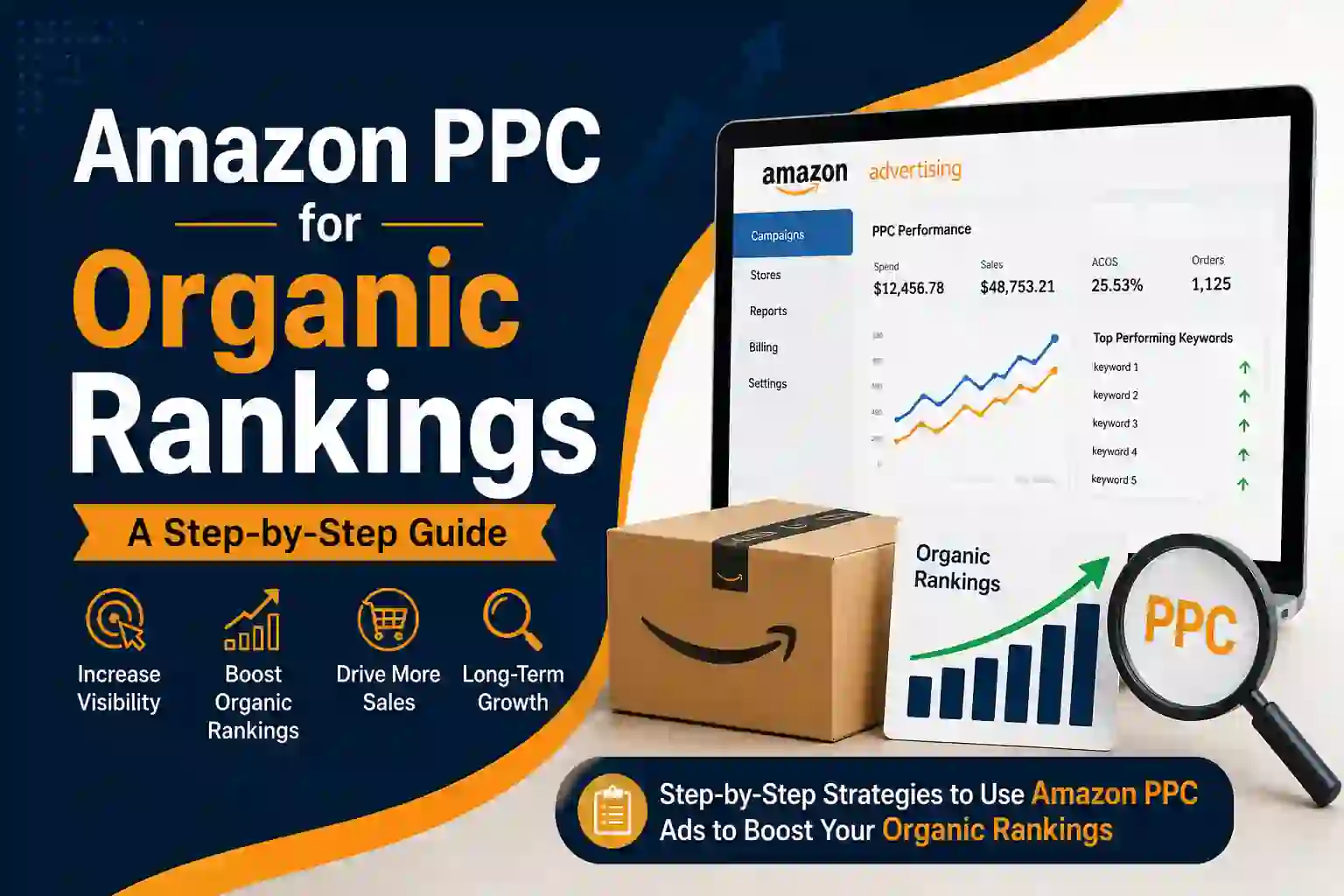
Amazon PPC for Organic Rankings: A Step-by-Step Guide

Success on Amazon is no longer determined by listing a product onto the platform and sitting back to let it sell itself. With how many products the shoppers have to choose from, millions! sellers need a visibility strategy that combines advertising and (SEO). Using Amazon Ads is one of the highly leading ways to lend a hand to enhance the organic ranking of your product.
Most sellers have a common misconception that Pay-Per-Click (PPC) advertising generates paid traffic only. That may be true, but experienced Amazon sellers know that an effective advertising campaign run well can boost organic rankings over time as well. That’s due to the fact that Amazon’s algorithm likes products that consistently get a lot of sales, conversion and experiences as high.
Understanding Amazon Organic Rankings
Organic rankings – the unpaid organic positions at which products are displayed in Amazon search results.
What is organic listings: When someone searches for wireless earbuds, any product that comes up without the tag (Sponsored) are organic results.
Higher organic rankings mean:
More free traffic
Increased visibility
Higher customer trust
Better conversion rates
Reduced advertising costs over time
As far as long-term profits go, organic visibility is often responsible for the most significant sales because naturally customers will click on the top products.
How Amazon’s A10 Algorithm Works
Amazon has a new ranking system (commonly called the A10 algorithm) that seeks to show shoppers those products which best lead to sales.
Important ranking signals include:
Sales history
Conversion rate
Click-through rate (CTR)
Keyword relevance
Customer reviews
Product availability
Competitive pricing
Inventory levels
Customer satisfaction
Advertising performance through increased sales
While Amazon has never officially confirmed from A-Z every single ranking factor, reports from experienced sellers with large ad-budget allocations show us that successful advertising will in fact indirectly boost organic rankings by sending off the sales signals the algorithm is looking for.
Does Amazon PPC affect organic rankings directly?
The short answer is:
No.
You take your listing and go to Amazon Ads, but there is no direct correlation telling the algorithm that this needs to rank higher.
Rather, PPC improves a number of performance signals that impact rankings, including:
Increased sales velocity
Better conversion rates
More customer engagement
Improved keyword relevance
Stronger sales history
When these metrics get better, Amazon sees your product as more relevant and it slowly starts to rise the organic rank.
Consider PPC your organic turbo engine and not a direct ranking factor.
Amazon PPC vs Organic SEO [What is the Relationship?
Never Consider Amazon PPC and SEO as Separate Practices
Instead:
PPC drives initial traffic.
↓
Customers purchase your product.
↓
Sales velocity increases.
↓
Your listing becomes more trustworthy for Amazon.
↓
Organic rankings improve.
↓
Free traffic increases.
↓
Advertising dependency decreases.
This cycle is called Amazon Growth Flywheel.
Sale velocity: The strongest ranking signal
Sales velocity means how fast you consistently register sales on your product.
Amazon perceives products that turn over more as being most relevant.
For example:
Product A
5 sales per day
Product B
50 sales per day
When comparing two listings that are equally optimized, Product B would typically be ranked higher simply because Amazon deems it a more popular option.
That momentum is built with the help of Amazon Ads, especially for:
New products
Seasonal items
Competitive niches
Product launches
Keyword Targeting Strengthens Relevance
Amazon Ads based on high-relevance customer search records
Example:
For example, if you sell a stainless steel water bottle, your PPC may be targeting keywords like:
insulated water bottle
sports water bottle
metal water bottle
reusable water bottle
vacuum bottle
When shoppers search these terms over and over again and buy your product, Amazon starts to associate your listing more strongly with those keywords.
Next, it helps you improve your organic rankings in Google search results for those particular keywords.
Better Click-Through Rate (CTR)
Comparison between Impressions and CTR: A higher CTR means that a more significant percentage of users have clicked your listing after viewing it.
A higher CTR tells Amazon:
Your product image attracts attention.
Your title is compelling.
Your pricing is competitive.
Your listing is relevant.
This set of developments largely corresponds with Amazon Ads increasing impressions, therefore enabling sellers to need different:
Main images
Titles
Prices
Coupons
Brand messaging
Usually, better CTR also means improved organic performance.
Conversion Rate Matters Even More
Traffic alone isn’t enough.
Amazon is all about getting shoppers to buy stuff.
Amazon gets a weak signal for example if 100 people click on your listing and only one person buys.
In the case of 100 visitors which lead to 20 purchases, Amazon has reason to celebrate as there is a high visitor purchase satisfaction.
The conversion rate plays a critical role in long term organic rankings.
PPC Helps Generate Reviews Faster
Usually greater sales means more reviews are written.
While Amazon does not allow incentivized reviews, increasing real purchases generally leads to more genuine customer feedback.
Products with:
Higher ratings
More reviews
Better customer satisfaction
tend to convert at a higher rate — which also boosts organic rankings.
Product Launch Strategy
Without PPC, launching a new product is like trying to light your car on fire in the middle of the night.
Without any sales history, Amazon has no incentive to rank the product organically.
A successful launch usually includes:
Automatic campaigns
Manual keyword campaigns
Exact match targeting
Sponsored Products
Sponsored Brands (for registered brands)
The key is to create sales early on to build ranking momentum.
The Most Effective Sponsored Products
Among Amazon advertising options:
Sponsored Products
Highest conversion rate
Direct product visibility
Best for keyword ranking
Ideal for launches
Sponsored Brands
Increase brand awareness
Showcase multiple products
Improve store visits
Sponsored Display
Retarget previous visitors
Recover abandoned customers
Increase repeat purchases
Sponsored Products typically provide the best return on investment for organic ranking improvements.
Listing Optimization Is Essential
A well-written product listing cannot be replaced by some of the best PPC campaigns.
Optimize:
Product Title
Include your primary keyword naturally.
Bullet Points
Talk about benefits and not features.
Product Description
Answer customer questions clearly.
Backend Search Terms
Include relevant keywords without repetition.
Images
Invest in Professional product images that show the item from different angels and real Use Images.
A+ Content
A+ Content should also be used to boost customer confidence and conversions for registered brands.
Inventory Management Matters
De-stocked can hit organic positions hard.
If your product becomes unavailable:
Sales stop.
Rankings decline.
PPC performance suffers.
Competitors gain market share.
Keep inventory in check, keeping them balanced during promotions and the busy season.
Lowering ACoS While Growing Organically
ACoS or Advertising Cost of Sales — The percentage that shows what proportion of our sales was used to pay for ads, so it measures the advertising spend against attributed sales.
As organic rankings improve:
Organic traffic increases.
Paid dependency decreases.
Advertising efficiency improves.
Profit margins grow.
Most of the successful sellers typically re-invest any savings made from advertising into growing their business.
Top 10 Common Mistakes Killing Your Organic Rankings
Avoid these common errors:
Targeting irrelevant keywords
Overspending on broad match campaigns
Ignoring negative keywords
Poor product images
Weak titles
Low-quality descriptions
High pricing
Stockouts
Inconsistent campaign optimization
It lowers the conversion rate causing TPR (Third-Party Record) loss through focusing only on clicks
Best Practices on Leverage Amazon Ads for Organic Rankings
Supercharge your listing prior to advertising them.
Conduct thorough keyword research.
Start with Sponsored Products.
Observe and use both automatic and manual advertising.
Monitor search term reports weekly.
Import high-performing keywords into exact match campaigns,
Remove underperforming keywords.
Employ negative keywords to mitigate the risk of wasted spend
Test bids regularly.
Improve images and A+ Content.
Maintain competitive pricing.
Keep products in stock.
Monitor conversion rates.
Monitor keyword rank improvements over time.
Measuring Success
Key metrics to monitor include:
Organic keyword rankings
Total sales
Organic sales percentage
Click-Through Rate (CTR)
Conversion Rate (CVR)
Advertising Cost of Sales (ACoS)
Return on Ad Spend (ROAS)
Impressions
Cost Per Click (CPC)
Total Advertising Cost of Sales (TACoS)
Instead of just measuring ACoS, consider whether or not your campaigns are growing total sales and increasing organic visibility.
FAQs
Well, does Amazon Ads directly correlate to improved organic rankings?
Amazon Ads do not directly rank,, but they lead to increasing convert, sales velocity and keyword relevance that causes organic rank to become higher.
Amazon Ads will generally have a positive impact on your organic rankings very soon after launch in terms of days rather than months.
Results depend on category and competition, however most sellers see improvement in their sales results after 4–12 weeks of running good campaigns with regular sales.
So, what type of Amazon ads work best for organic rankings?
The reason sponsored products are typically the most successful is because they are appearing to shoppers in-market for particular products too where conversion rates tend to be highest.
Can I rank organically without Amazon PPC?
Yes, although it will take way much slower. PPCs primary purpose is getting sales via paid advertisements for both new and established product launches to essentially help the listing gain momentum to achieve better organic visibility.
Does spending more on Advertising mean bigger rankings?
No. It depends on having keywords right, optimization of your listing, competitively priced and whether listings convert or not – spending more does not equal success.
ACoS vs TACoS
Comparison While you can analyse your ad campaigns on both metrics independently, you will find that you could use one to examine the other.
ACoS is ad spend divided by ad-attributed sales, while TACoS compares ad spend to total sales (both paid and organic). A lower TACoS is generally a sign that organic sales are increasing.
Are failed PPC campaigns detrimental to organic rankings?
Indirectly, yes. The disorganized ad spend, waste in traffic and thumbs down leads can cause less enhancement of the overall campaign payoff with an unwelcomed foil of calumny growth.
What you do while organic and PPC rankings align How long to maintain a PPC campaign in the same SERP as your organic ad
Not necessarily. Most successful sellers keep buying ads to retain top positions; they are expanding by introducing new keywords and keeping competition at bay while increasing or cutting budgets based on return.
Conclusion
Amazon Ads and organic SEO are not competing strategies; when used together, they work best. Well planned PPC campaigns can supercharge sales, enhance keyword relevance, drive up conversion rates, and create the kind of momentum that supports powerful organic rankings. Amazon Ads is an investment tool that pays good returns over time, provided it is supplemented by a well-optimized product listing, a competitive price point, customer reviews & feedback management, and inventory management.
To focus on PPC, consider it an investment for your product’s visibility and organic success in the future rather than just an expense. This enables you to gradually diminish the reliance on advertising while maintaining consistent and profitable organic growth through data-driven optimizations.