AMAZON FBA FEES EXPLAINED FOR SELLERS

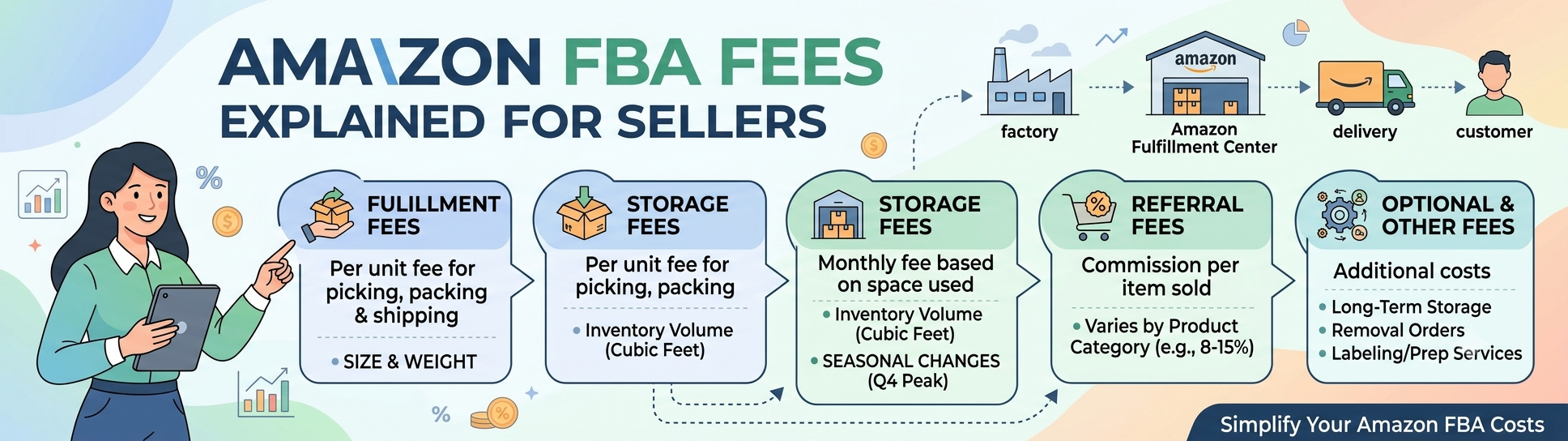
AMAZON FBA FEES EXPLAINED FOR SELLERS
Selling on Amazon can be highly profitable, but understanding the platform’s fee structure is essential before launching or scaling a business. Many sellers jump into Fulfillment by Amazon (FBA) without fully understanding the costs involved, and later struggle with reduced profit margins. That is why learning Amazon FBA fees is one of the most important steps in building a successful Amazon business.
At AMZ-DOC, we help Amazon sellers understand every part of the selling process, from account setup to advanced optimization strategies. If you are new to Amazon selling, you may also find our guides on Amazon-related services helpful through AMZ-DOC resources.
This guide explains Amazon FBA fees in simple terms so you can calculate costs, protect profits, and make smarter business decisions.
What Is Amazon FBA Service?
Amazon FBA stands for Fulfillment by Amazon. It is a service where Amazon stores your products in its warehouses, packs customer orders, ships them, and even handles customer service and returns.
This means sellers do not need to manage packing or shipping themselves. Instead, Amazon charges several fees for these services.
FBA is popular because it gives sellers access to Amazon Prime customers, faster shipping, and better trust among buyers. However, convenience comes with costs.
Understanding those costs helps you answer a critical question:
Are you actually making profit after fees?
Main Types of Amazon FBA Fees
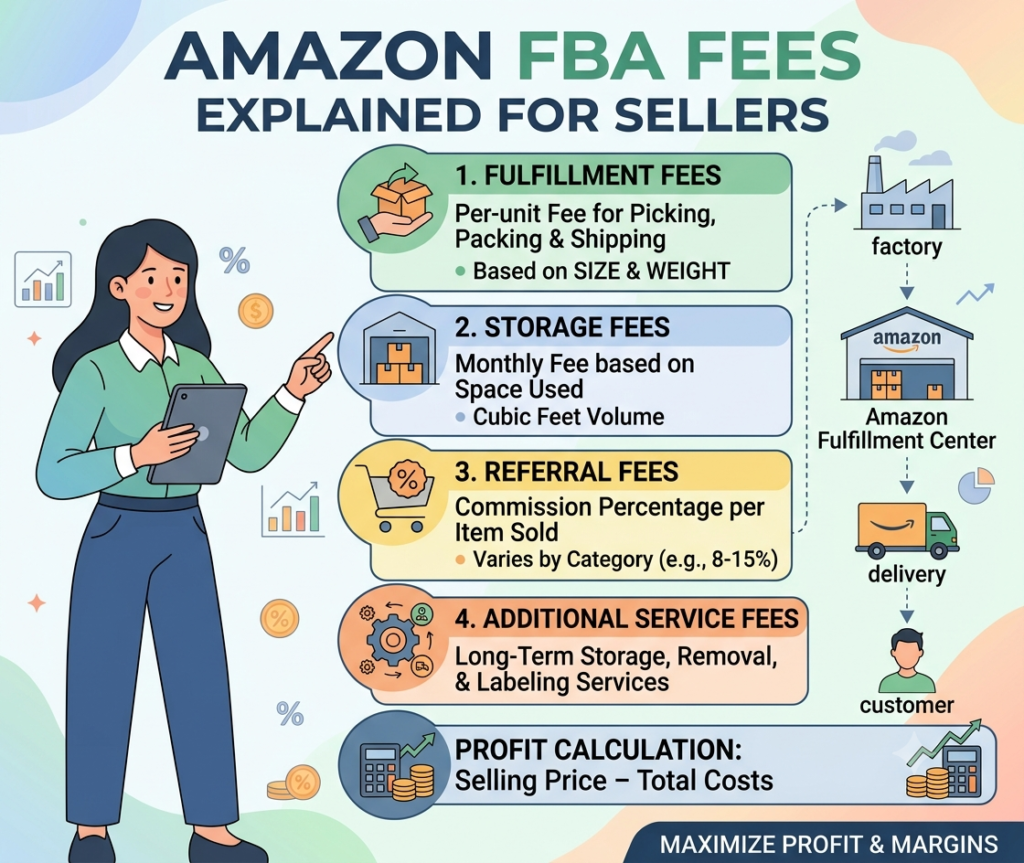
Amazon FBA fees are generally divided into four major categories:
- Referral fees
- Fulfillment fees
- Storage fees
- Additional service fees
Let’s look at each one.
Amazon Referral Fees Breakdown
A referral fee is the commission Amazon charges whenever you make a sale.
Think of it as Amazon’s percentage for allowing you to sell on its marketplace.
Most categories have referral fees between 8% and 15%, though some can be higher or lower.
Examples:
- Home & Kitchen: around 15%
- Electronics: around 8%
- Clothing: usually 17% for certain price ranges
For example, if your product sells for $50 and Amazon charges 15%, your referral fee would be:
$50 × 15% = $7.50
That means before any other cost, Amazon keeps $7.50.
When calculating product profitability, referral fees must always be included.
At AMZ-DOC, we often advise sellers to review category fees before product selection because choosing the wrong category can reduce margins significantly.
Amazon Fulfillment Fees Explained Clearly
Fulfillment fees cover the cost of:
- Picking products from shelves
- Packing orders
- Shipping to customers
- Handling customer support
These fees depend mainly on:
- Product size
- Product weight
- Packaging dimensions
Smaller and lighter products cost less.
For example:
A small lightweight item may cost around $3–$4 in fulfillment fees.
A heavier product may cost $8 or more.
This is why product dimensions matter so much in FBA.
Even slight packaging changes can reduce fees.
For example, reducing unnecessary packaging may move your item into a lower size tier, saving money on every sale.
This becomes huge at scale.
Imagine saving $0.50 per order across 10,000 orders.
That equals $5,000 saved.
Smart sellers constantly optimize packaging.
Monthly Storage Fees Overview
Amazon charges storage fees because your inventory occupies warehouse space.
Storage fees are calculated based on:
- Product volume in cubic feet
- Time of year
- Storage duration
Usually, storage costs increase during peak seasons such as Q4 (October to December), when warehouse demand rises.
If you overstock inventory, storage fees can become expensive.
For example:
Products sitting unsold for months cost money every single month.
This reduces cash flow and profits.
Efficient inventory planning is essential.
Good sellers balance stock carefully:
- Enough inventory to avoid stockouts
- Not so much that storage fees rise
Inventory forecasting is one of the most overlooked skills in Amazon selling.
Long-Term Storage Fees Matter
If products remain in Amazon warehouses too long, extra fees apply.
These are called aged inventory fees or long-term storage charges.
This usually happens when inventory stays unsold for many months.
Common reasons include:
- Poor product demand
- Weak listing optimization
- Wrong pricing strategy
- Bad keyword targeting
If products are not selling, the problem may not be inventory alone.
Sometimes the listing itself needs improvement.
This is why optimizing product visibility matters.
For help improving listings and performance, sellers often rely on professional support like the services offered by AMZ-DOC.
Additional Amazon FBA Fees
Beyond core fees, Amazon may charge additional service fees.
These include:
Removal Fees
If you want Amazon to return unsold inventory to you, removal fees apply.
This happens when sellers want to:
- Liquidate stock
- Repackage products
- Switch fulfillment methods
Disposal Fees
If inventory is damaged or unsellable, Amazon can dispose of it for a fee.
Returns Processing Fees
Certain categories may include return processing charges.
Returned products can impact profitability significantly.
Labeling Fees
Amazon may charge fees if products require labeling or prep services.
Examples include:
- Bubble wrapping
- Poly bagging
- Barcode labeling
Preparing inventory correctly before shipment helps reduce these costs.
How To Calculate FBA Profit
Every seller should know this basic formula:
Profit = Selling Price – Total Costs
Total costs include:
- Product sourcing cost
- Shipping to Amazon
- Referral fees
- Fulfillment fees
- Storage fees
- Advertising cost
- Returns
Example:
Selling price: $40
Product cost: $10
Shipping to Amazon: $2
Referral fee: $6
Fulfillment fee: $5
Ads: $4
Total costs = $27
Profit = $40 – $27 = $13
Your profit margin is:
13 ÷ 40 × 100 = 32.5%
This is why sellers must calculate numbers before launching products.
A product with high sales volume can still lose money if fees are ignored.
Ways To Reduce Amazon FBA Fees
You cannot eliminate Amazon fees completely, but you can reduce their impact.
Here are practical strategies.
Optimize Packaging Size
Smaller packaging often lowers fulfillment costs.
Avoid oversized boxes or unnecessary inserts.
Improve Inventory Turnover
Products that sell faster generate less storage cost.
Focus on demand forecasting.
Choose Better Products
Products with:
- Low weight
- Small size
- High margins
usually perform better in FBA.
Monitor Advertising Spend
Amazon PPC costs can eat profits quickly.
Track ad performance regularly.
Fix Poor Listings
Low conversions often cause slow-moving inventory.
Improve:
- Images
- Titles
- Keywords
- Bullet points
- A+ Content
At AMZ-DOC, we help sellers optimize these critical areas to improve performance and reduce wasted costs.
Is Amazon FBA Worth It?
This is a common question.
The answer depends on your business model.
FBA is worth it if you want:
- Fast shipping
- Prime eligibility
- Scalable operations
- Less logistics stress
FBA may be challenging if:
- Your margins are too low
- Products are oversized
- Inventory moves slowly
Many successful sellers still choose FBA because it saves time and allows focus on growth.
Instead of managing daily shipments, they focus on:
- Product research
- Branding
- Marketing
- Scaling sales
Time savings alone can justify FBA fees.
Final Thoughts on Amazon FBA Fees
Amazon FBA offers incredible opportunities, but success depends on understanding costs.
Many new sellers focus only on revenue.
Experienced sellers focus on profit.
That is the real difference.
Before launching any product, calculate every possible fee carefully.
Ask yourself:
- What is my total landed cost?
- What is my actual margin?
- Can my business remain profitable after advertising?
The more accurately you calculate Amazon FBA fees, the better decisions you make.
At AMZ-DOC, our goal is to help sellers navigate Amazon with confidence. Whether you need guidance on account management, listing optimization, or growth strategies, understanding fees is the foundation of a profitable Amazon business.
Master your numbers, protect your margins, and build smarter.