AI-Generated Product Media: 3D Models, Virtual Try-Ons & Synthetic Imagery

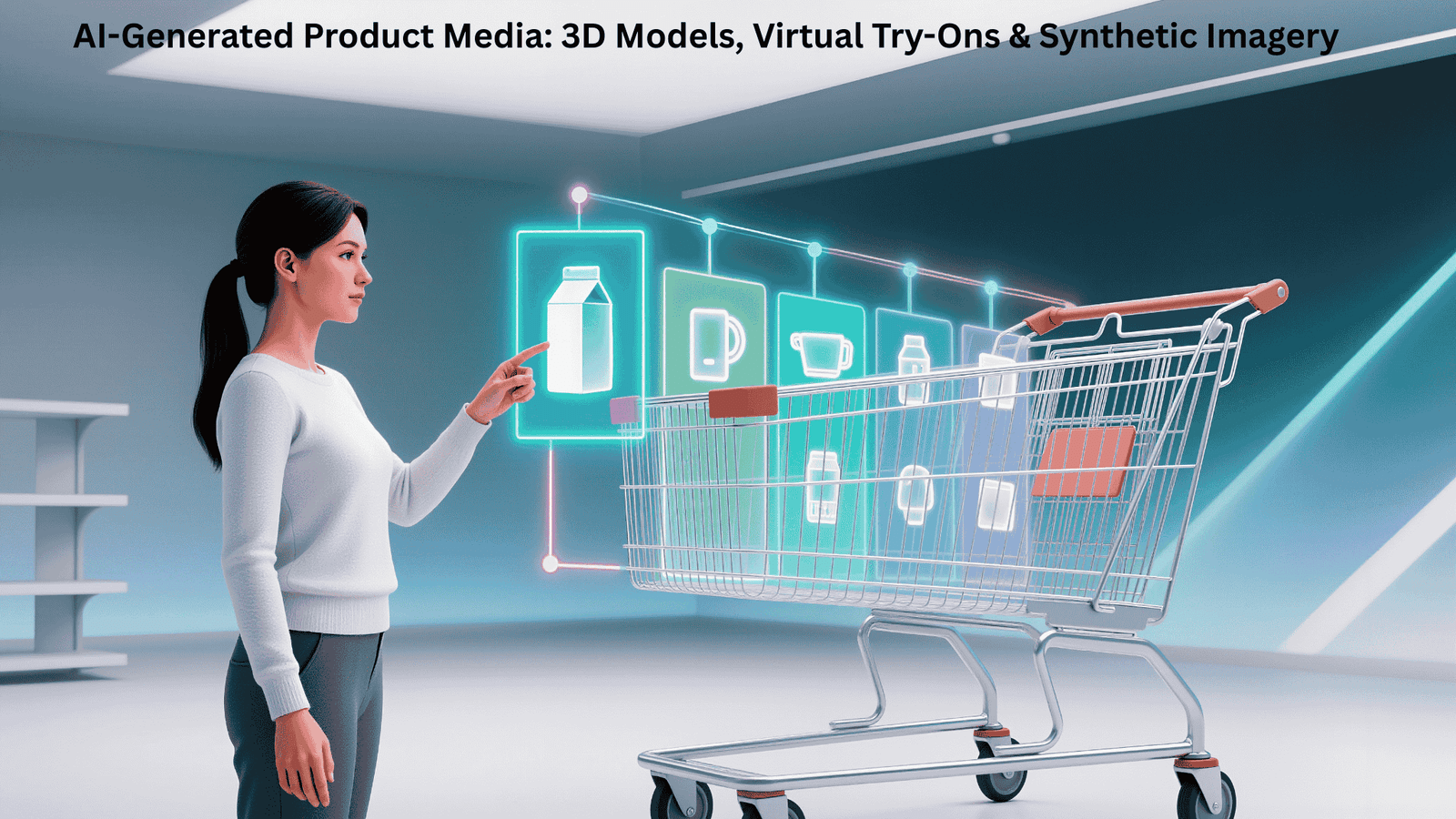
Online marketplaces generally compete through visual content which is the greatest motivator driving consumer purchasing behavior. Use of immersive and interactive multimedia is not a luxury, but a necessity. The formation of AI-Generated product media is built upon these principles, utilizing 3D models, virtual try-on options, and synthetic imagery.
AI is changing the paradigm for how product visuals are created and presented. Products visual media is more accurate, scalable, and cost-effective. No industry is stimulating online purchasing behavior more than the fashion and beauty, furniture, and electronics industries.
Determining how product media works, its benefits and challenges, industry, and global trends will help demonstrate the viability for businesses to utilize product media.
What is AI-Generated Product Media?
The term AI-generated media involves the unique visual elements of a product created or enhanced with the use of machine learning rather than irrational diversions like photography and illustrating with 3D computer software. AI-generated media includes:
AI-generated 3D product models
Virtual product try-on applications
Images and videos of synthetic products
AI-enhanced lifestyle scenes and backgrounds
AI-generated media is not static, unlike photos; it changes for different users, and situations, and thus, multimedia in e-commerce is interactive.
Why Visual Experience Matters in E-Commerce
Research in consumer buying behavior shows that for over ninety percent of online users, visual content predominates when purchasing products. If visual content is poor, the following outcomes can occur:
Buyers hesitate
Expectations get mismatched
The product gets returned at a high rate
The online brand is not trusted
The problems above get solved with AI-generated product media, providing visualization, and making the purchase more realistic or giving a potential buyer confidence.
The Main Elements of AI-Generated Product Media
3D Product Models, AI Generated
AI-generated 3D product modeling enables companies to make digitally, accurately, and realistically representative, rotatable, and zoomable products.
How it Works.
The product’s images, computer-aided design (CAD) files, scans, or design contents are input into AI algorithms that analyze and create a 3D digital copy of the product.
Benefits
Interactivity allows customers to engage with products
Uniformity in imagery across all platforms
Elimination of need for several photo shoots
Quicker time to market for products
Industries Using AI 3D Models
Home furniture and decor
Consumer electronics
Automobiles
Consumer product goods
Virtual Try On Technology Made Possible With AI
Virtual try-on technology allows customers to see how a product looks on them or in their space before deciding to make a purchase.
Common Use Cases
Trying on clothing, footwear and fashion accessories
Makeup application and hairstyle testing
Previewing watches and eyewear
Furnishing a space in a room
AI Technologies Involved
Computer vision technology
Facial recognition technology
Body mapping technology
Augmented reality
Impact on Buyer Confidence
Virtual try-ons eliminate the guesswork for customers with respect to:
Fit
Size
Color
Style Compatibility
Fewer returns stem from these factors, resulting in higher customer satisfaction.
Synthetic Imagery and AI Generated Photos
Synthetic imagery refers to the creation of product photos and videos that, while appearing photorealistic, were not captured with a camera.
Key Features
Backgrounds created by AI
Lifestyle imagery created without using actual physical filming sets
Weather, environmental light, and lighting simulation
Infinite scene variations for one product model
Why Brands Are Switching
Decreased production costs
Absence of logistics and location expenses
Rapid creation of content
Simplified localization of content for diverse global markets
Synthetic imagery is especially effective in animation, marketing campaigns, ad creation, and social media.
Augmented Buyer Experience with AI-Generated Product Media
1. Enhanced Understanding of Product
AI images give:
– 360-degree visualizations
– Approximated size and proportion
– Options to interact in detailing the products
With this understanding, customers know what to expect without the risk of disillusionment in the future.
2. Enhanced Personalization of Shopping Experience
AI produces previews of the product tailored to:
– Body type
– Skin tone
– Size of the room
– Preferences and behavior
Such customizations lead to higher personalization of the product offerings akin to the user having personal shopper assistance.
3. Decreased Cognitive Load
Customers do not have to envision the product as it may look like in their possession as they can see the product with various forms of previews instantly. It affords them the luxury of saving time in making buying decisions.
4. Enhanced Trust and Transparency
High-quality AI images increase credibility:
– By providing accurate and consistent images
– By avoiding inaccurate and misleading images
– By consistent branding across platforms
This elevated trust translates to increased user activity which impacts conversion rates positively.—
Mitigating Product Returns Through AI-Generated Visuals
Return rates in e-commerce are problematic, particularly in the fashion industry and the furniture industry. AI-generated images help by:
Demonstrating accurate size and fit
Showcasing realistic colors and textures
Providing a virtual test of products
Actual Impact
Using virtual try-on tools, retailers experience:
Sharp reduction of up to 40% in returns
Increased frequency of repeat purchases
Reduced costs of operations
Increasing AI Product Media As A Means For Driving Sales
AI-generated visuals capture and affect the following:
Variable Effect
Engagement Amplified duration on a product page
Assurance Decrease of hesitation to make a purchase
Transparency Reduction of those who leave a site without completing a purchase
Velocity Accelerated pace of a purchase
After the application of AI-generated visuals, various brands report increases of 20-30% in the rate of products purchased.
Industry Use Cases
Fashion & Apparel
Artificial intelligence size prediction.
Virtual fitting rooms.
Synthetic photography for fashion.
Beauty & Cosmetics
Makeup applications.
Matching skin tones.
Simulations of hairstyles.
Furniture & Home Decor
Visualizing rooms.
Accuracy of scale and spacing.
Compatibility style previews.
Electronics
Views of products in 3D interactively.
Visualizing internal components.
Automotive
Configurators for cars in 3D.
Previews of both interiors and exteriors.
Cost Efficiency and Scalability
Traditional photography for products and modeling takes time and adds great expense. AI changes this by:
Automating the creation of assets.
Reusing 3D models in different channels.
Visual creation of thousands of skus.
This creates great opportunity for AI-generated product media for direct to consumer brands and merchants, as well as retailers who operate on a global scale.
Industry Use Cases
DTC, Digital Transformation Centre, suggests that AI generated product media has the following challenges:
1. Initial Setup Costs.
Quality AI systems are expensive, and there are questions around an initial investment.
2. Data Quality Dependence.
There are limitations on input images. AI has to depend on clean product data and uncompressed images of high resolution, as accuracy may be impacted.
3. Ethical and Transparency Concerns.
Trust may be impacted as brands are required to be open and honest about the images that are generated and altered.
4. Technical Integration.
Integration may require technical proficiency for the use of AI visuals across online platforms.
FAQ
1. What do you mean by AI-generated product media?
AI-generated product media refers to artificially created product media like 3D models and synthetic images (including those that have been altered using AI) that can be used to depict products more realistically (or even virtually) for online modeling.
2. How do AI product media mitigate return rates?
AI media have the potential to demonstrate fit, size, color, and real-world likeness adequately, eliminating the expectations mismatch that leads to return order fulfillment.
3. Do you think AI-generated images are more advantageous than photography?
AI-generated images are more efficient and cost saving than traditional photography. However, many brands tend to have a combined approach.
4. Which industries do you think benefit the most from AI product visuals?
Due to the heavy reliance on visuals, the industries that benefit the most from the products are the fashion, beauty, furniture, electronics, automotive, and home décor industries.
5. Do you need any specific hardware for virtual try-ons?
Most modern virtual try-ons do not require any specific hardware apart from mobile phones, tablets, and browsers.
6. How much do you think AI-generated product media are?
The initial investment can be quite considerable, however, in the long run, the costs that come with unsatisfied customers, photoshoot, and return excess can outweigh the investment.
7. Can small businesses utilize AI product media?
The answer is a clear YES, as most AI products are scalable and are not clods to small and medium businesses.
8. Do you think that using AI-generated imagery is ethical?
The answer is Yes. As long as there is full transparency and accuracy in the use of AI. AI disclosure is however a necessity.
Conclusion
AI-generated product media is not a futurist vision, but rather a requirement for competitiveness in modern e-commerce; the use of 3D models, virtual try-ons, and synthetic imagery, brands now have the ability to construct personalized immersive shopping experiences that increase conversion rates, decrease return rates, and create long-lasting relationships with consumers.
Those businesses that integrate visual AI today will be the forerunners of tomorrow in the digital marketplace, as consumer demand only continues to increase.