Advanced Multi-Channel Fulfillment to Scale eCommerce

Advanced Multi-Channel Fulfillment Strategies to Scale Your eCommerce Business
Advanced Multi-Channel Fulfillment Strategies: Optimizing Fulfillment Across FBA, Third-Party Logistics, and Direct-to-Consumer Channels with AI-Driven Orchestration
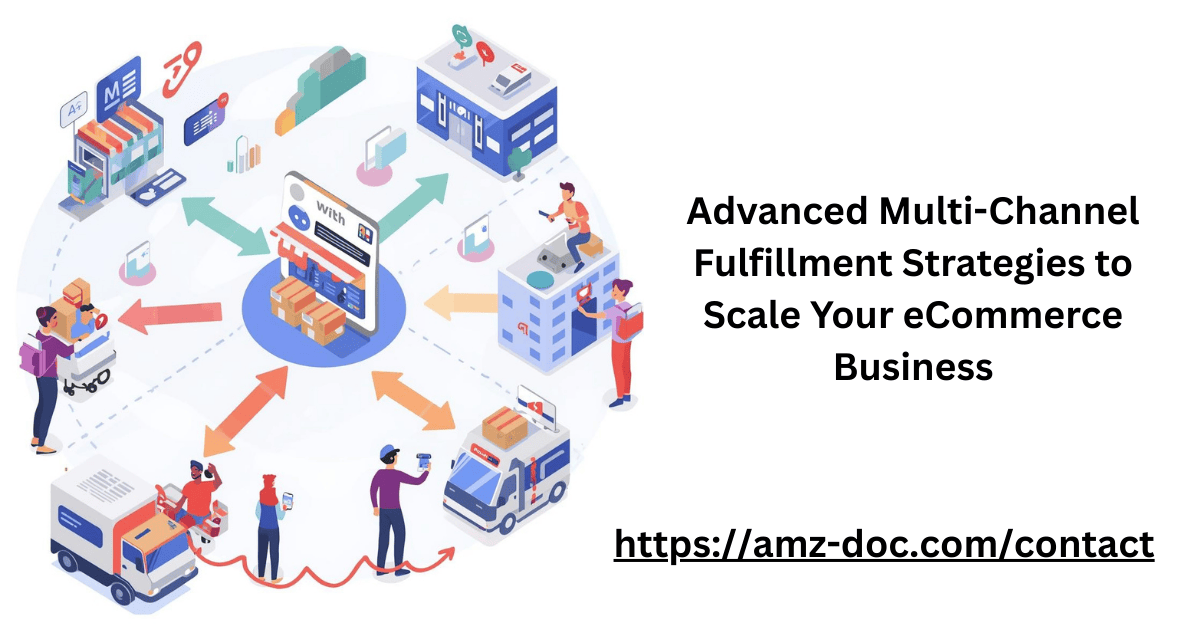
The e-commerce world has become a battlefield, and sellers are not safe selling on just one channel. It has become common for customers to buy on the marketplace, then buy directly from the brand. Retail customers expect a seamless shopping experience. Because of this, multi-channel fulfillment (MF) has become a top strategy. Businesses that do not manage fulfillment on multiple channels will experience a greater loss of cash flow, loss of customer confidence, and greater operational costs.
Ready to Scale Your eCommerce Business?
Managing inventory, orders, and shipping across multiple sales channels can be complex. With advanced multi-channel fulfillment strategies, businesses can streamline logistics, maintain synchronized inventory, and deliver faster across platforms like Amazon, Shopify, and Walmart. Efficient fulfillment systems help brands expand their reach while keeping operations smooth and scalable.
At AMZ DOC, our experts help you optimize fulfillment workflows, integrate marketplaces, and scale your eCommerce operations with proven strategies.
Get expert support today:
https://amz-doc.com/contact/
What is multi-channel fulfillment?
When multiple sales channels work together, this is called multi-channel fulfillment, or MCF. In contrast to MCF, single-channel fulfillment is where orders are processed from one destination (such as direct e-commerce websites). MCF is where order processing has multiple sales channels, which include:
Marketplace channels
Amazon, eBay, Walmart, Shopify, etc.
Direct-to-consumer channels
Brand website or app.
Physical retail channels
Brick-and-mortar stores or omnichannel distribution.
In MCF, it is important to keep customers satisfied across all channels, which can also be achieved by lowering fulfillment costs and optimizing order processing.
Most important fulfillment channels:
1. Fulfillment by Amazon (FBA)
Amazon has fulfillment centers where sellers can store their inventory and have Amazon handle storage, packing, shipping, and customer service. Advantages of having FBA include:
Prime eligibility – Orders can qualify to be shipped with Amazon’s fast shipping.
Increased sales – Sellers no longer need to handle their own warehouse and shipping.
Easier demand spikes – Demand spikes can be processed more easily with FBA as Amazon works to keep warehouse levels managed.
FBA also has negative aspects to be considered:
Less control over packaging and inventory.
More expensive storage and fulfillment service during peak seasons.
Less control over operational costs – Amazon manages shipping and returns, which means if shipping is delayed due to operational costs, they own it.
FBA is most beneficial to sellers with high-volume SKUs that have consistent demand.
2. Third-Party Logistics (3PL)
3PL companies provide warehousing, inventory control, and shipping services for outsourced company logistics. This type of company allows businesses to do the following:
Flexibility
Outline various fulfillment providers based on geographical coverage.
Cost Optimization
Shipping, storage, and labor costs need to be balanced.
Consistent Customer Experience
Delivery times, packaging, and return policies must be consistent.
Data silos
Integrated decision-making is difficult due to fragmented data across marketplaces, logistics, and internal systems.
To tackle these obstacles, overcoming siloed systems, centralized fulfillment, and AI-driven orchestration is crucial.
Multi-Channel Fulfillment Orchestration With AI
AI-driven orchestration is the coordination of fulfillment operations across multiple channels using artificial intelligence. This method alleviates the most significant frustrations associated with multi-channel fulfillment:
Inventory Optimization
AI can determine demand across channels by analyzing market trends, historical sales data, and seasonality. This allows for:
Optimal stock allocation – Shipment of inventory to the closest fulfillment center to regions with high demand.
Stockout anticipation – AI can identify demand spikes.
Storage costs reduction – Prevents under- and over-stocking.
AI can determine which SKUs should remain with 3PL partners for regional fulfillment and which should be with FBA centers for Prime customers.
Dynamic Order Routing
Deciding what fulfillment channel to use for an order can be challenging for an AI powered multi-channel retail business. Routing can be optimized based on these factors:
Delivery Speed: In case of urgent orders that are time-sensitive, FBA or DTC fulfillment can be prioritized.
Cost Efficiency: The most cost-effective option can be selected without impacting on-time delivery.
Inventory Levels: Shipping can be avoided from a center that is low on stock.
This kind of order management can ensure that delivery time for customers is improved, while operational costs are reduced.
Predictive Replenishment
Order fulfillment centers (FBA, 3PL or Brand-owned fulfillment hubs) are integrated with an AI-controlled replenishment system. With AI, Replenishment orders can be automatically generated based on the rate of inventory depletion.
This approach definitely improves the resiliency of the supply chain and also minimizes lost sales due to stockouts.
Automation and Workflow Optimization
AI is capable of performing several repetitive functions and with that, many Workflow Optimization can be performed. These include:
Managing returns over all channels
Real-time channel-inventory visibility
Creating and managing shipping labels
Channel routing order fulfillment
These tasks can be performed without human intervention for increased accuracy and reduced error rate, and the Staff of the business can be free to perform other more valuable and strategic tasks.
Advanced Fulfillment Strategies
To optimally utilize all fulfillment channels, retail businesses can implement the following:
Channel Segmentation
Not every stream of products or SKUs is ideal for every channel. Inventory can be segmented based on:
Product Velocity
SKUs that are fast moving should be directed to FBA for Prime customers.
Geographic Demand
For 3PL distribution centers, Regional Demand can be applied to determine the stock.
Direct to Consumer Fulfillment
Since marketplace fees are charged based on order value, direct to consumer fulfillment can be prioritized for orders with high-margin products.
Blended Fulfillment Network
Consider utilizing FBA, 3PL, and DTC fulfillment for a more adaptable fulfillment network.
FBA can be used for high-volume orders on the marketplace.
3PL is more cost-effective for regional distribution.
DTC offers the ability to use more personalized packaging and branded experiences.
Blended networks ensure a balance of speed vs. cost vs. customer experience.
Inventory Visibility and Management
Centralized inventory management offers:
Unified views and alerts across all stocks.
Dashboards and alerts for low stock and overselling.
AI demand forecasting.
This ensures confirmed stock availability.
Returns Management
Returns are a fact of e-commerce and can be managed through a complicated series of:
Streamlining the return to the appropriate warehouse or 3PL.
Automating the return notification process, refunds, and restock.
AI to analyze returns and lessen future occurrence.
Returns are necessary to improve customer satisfaction and lessen operational cost.
Performance Monitoring
The following KPIs provide data across all channels:
Fulfillment time.
Cost to ship.
Rate of return.
Level of satisfaction
AI can easily recognize areas of concern and promote changes.
Case Study: Active Application of AI-Driven Multi-Channel Fulfillment
Example: A mid-size consumer electronics brand with product listings on Amazon, its own website, and regional retailers. Challenges faced are:
Amazon stockouts during holiday seasons.
Website order shipping costs.
Differing and broken inventory records on a 3PL basis.
Solution:
Used AI for improved inventory forecasting.
Created dynamic order routing for order fulfillment to be fast and inexpensive.
Inventoried dynamically across FBA, 3PL, and DTC.
Automated handling of returns and alerts for stocks.
Results:
30% improvement of inventory stockouts on peak seasons.
15% improvement of shipping and handling costs.
Increase in customer satisfaction because of changes to delivery speed and reliability.
This proves the effective merger of AI with multiple channel fulfillment.
Strategies for Effective and Improved Multi-Channel Fulfillment
System Prioritization: Merge DTC and 3PL partners to a unified structure.
Artificial Intelligence: In the areas of forecasting, order routing, and returns, use predictive analytics and automation.
Work to maintain Consistent and Reliable Customer Experience.
Monitor and Control Fulfillment Costs: Regular analysis of fulfillment costs and optimizations of individual areas.
Define Channels and SKUs: Assign Specific Products to Specific Fulfillment Channels Based on Demand and Profit Margin.
Stay Agile – Adjust your methods regularly depending on what the market and your operations are telling you.
The Future of Multi-Channel Fulfillment
The future of fulfillment is being shaped by:
AI and machine learning
Updated methods for making both predictions and decisions are being developed.
Robotics and automation
These are speeds and accounts for precision in warehouse duties.
Sustainability
Improved delivery methods and eco-friendly packaging contribute to the reduction of our carbon footprint.
Omnichannel experiences
Improved integration exists for both and between the online and in-person sales experiences.
If your business is one of the first to implement any of these technologies, you will stand to benefit most by providing your customers with fulfillment services that are faster and more reliable, as well as cost-effective, regardless of location.
FAQs
Q1: What is multi-channel fulfillment?
A: The coordinated use of logistics to fulfill orders that are received from various sales channels, including market places, direct sites, and physical retail stores.
Q2: In what way does artificial intelligence enhance multi-channel fulfillment?
A: By optimizing the distribution of inventory, forecasting demand, and automating the routing of orders, as well as streamlining the reverse logistics (i.e. the logistics of returns) process, artificial intelligence reduces the time and cost associated with the delivery of any service.
Q3: Should I select FBA, 3PL, or DTC fulfillment?
A: The answer is dependent on your business objectives. For example, if you have significant orders in the marketplace, then FBA would be most suitable. In contrast, 3PL would be more flexible and regionally divergent. Additionally, DTC would be advantageous where personalized experiences for customers are preferred and profit margins are higher.
Q4: What strategies prevent overselling during multi-channel fulfillment?
A: Over-selling can be avoided by using central inventory systems with AI forecasting for real-time inventory position tracking.
Q5: What are blended fulfillment networks?
A: Blended fulfillment networks optimize speed, costs, and customer experience by integrating various channels, such as FBA, 3PL, and DTC.
Q6: What are the most effective methods for managing returns?
A: The most effective methods include automated routing systems for returns, using AI to track return behavior, and efficient restocking, all of which support improved operational loss and customer satisfaction.
Conclusion
The most advanced multi-channel fulfillment techniques are critical for the development of e-commerce businesses for the following reasons: Combining FBA + 3PL + DTC with AI-driven orchestration enables businesses to:
Optimize the allocation of inventory
Minimize operational expenditure
Provide customers with reliable and rapid service
Expand their business without incurring additional costs
Data-driven, tech-based strategies, including cross-channel systems integration and performance monitoring, are essential for adapting to the evolving customer expectations, sustaining market dominance and profitability in the complex world of e-commerce.